(editar com o módulo Customer Reassurance)

(editar com o módulo Customer Reassurance)

(editar com o módulo Customer Reassurance)
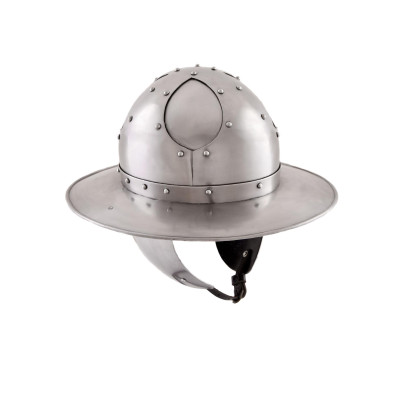
The kettle hat or war hat, a fairly simple helmet in the shape of a brim hat, came into vogue in the 13th century and enjoyed great popularity among foot soldiers, archers, crossbowmen, pikemen, and men-at-arms throughout Europe until the 15th century. It owes its name to its resemblance to a pot (originally called a kettle).
Although kettle hats existed in many variations, they all shared the same main feature: a wide brim that offered protection against downward sword blows and projectiles fired or dropped from above, without impairing the wearer's vision, hearing, or breathing. This design proved useful during sieges and massed infantry battles and contributed primarily to the enduring prevalence of this type of helmet. The so-called sallet developed from the kettle hat in the fifteenth century.
This reconstruction of a late medieval kettle hat is made of 1.6 mm steel (16 gauge). The edge of the flap is wrapped all the way around and four bands or plates (in German called Spangen) are arranged decoratively in the shape of a cross on the helmet bowl. In the overlapping areas, the thickness of the material is more than 5 mm. Dark brown leather straps with aged brass buckle are riveted to the two cheek guards.
The interior is blackened for better corrosion resistance. It is equipped with an adjustable padded lining made of high-quality black fabric and fastened with rivets.
Suitable for light combat staging, LARP, stage or TV/film, this wearable helmet is best suited for late medieval scenarios and ideal for completing the armour of a European warrior. Of course, it will also be a great addition to any helmet collector's treasure chamber.
Sword of Odin, the main god of Norse mythology. Includes hem.
The Night Watchman is a lightweight umbrella with a virtually indestructible carbon fiber rod that can support up to 200 pounds (90 kg) of weight. The handle is nylon reinforced with sturdy fiber and has a comfortable rounded handle and a release button. A sharp, penetrating glass breaker covers the end of the shaft. The umbrella comes in a sturdy nylon cover with handles for easy transportation.
Details:
- Total length: approx. 93 cm
- Cable: approx. 11 cm
- Weight: approx. 0.7 kg
The elegantly simple lines of the Paul Chen/Hanwei Golden Oriole Wakizashi have long been favored by admirers of the Japanese sword.
The story told by the impressive tsuba is of a praying mantis chasing a cricket, not knowing that he himself is being chased by a golden porcupine.
The blade is hand forged in high carbon steel and hardened differentially to display a distinctive hamon. The deeply varnished blue of the saya is repeated in Japanese cotton tsuka-ito , and a cricket motif appears again in kashira . Each Wakizashi comes with a custom cloth bag for proper protection and a Japanese blade maintenance kit.
The corresponding Golden Oriole Katana (Product No. SH1018) is also available to complete your collection.
Roman imperial helmet
This complex replica follows the example of helmets used in
about 300 BC in ancient Athens.
Flexible cheek protectors are covered with leather inside.
The plume can be mounted separately.
Delivery includes a padded lid.
Functional medieval steel barbuta of 1.6 mm. Includes leather chin strap. The barbuta served as a shelter for the head and had as an element the collar that defended the neck at the front and the cover that defended the neck from behind.
Large Tankard/Beer Mug, Genuine Vegvísir Horn This generously sized mug/tankard with handle is handmade from cattle horn, polished and adorned with an engraved vegvísir framed by a rune sequence.
The vegvísir (path finder) is a magical symbol or a so-called secrecy (galdrastafir) of Icelandic origin. A real representation of this symbol first appears in Geir Vigfússon's Icelandic Huld Manuscript of 1860, a collection of runes/spells and secrecies. It says:
If this signal is charged, the person will never lose his way in storms or bad weather, even when the path is not known.
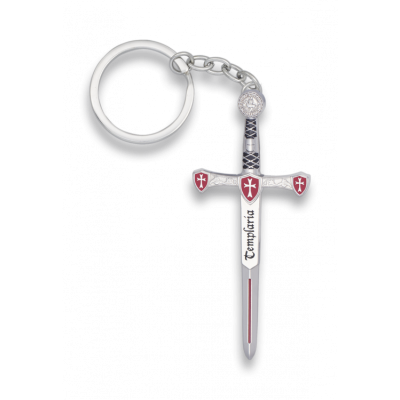
Keychain of the Templar sword enamelled in red. Made in Zamak.
Chinese butterfly swords
Still incredibly popular with martial artists and collectors, these iconic Chinese Butterfly Swords are loaded in pairs that are cleverly nested, so they appear to be a sword in the scabbard. But when they are taken, short swords can be separated and handled with both hands at the speed of light!
Our Viking Vendel helmet is HANDMADE from 16 gauge mild steel, lined with a padded liner (made from a thick layer of padding sandwiched between a thick high-quality canvas).
The base (24x21) cm leaves space for a maximum head circumference of 68 cm.
The eyepiece measures 16.5 cm wide and a nosepiece is 12.5 cm long.
The eye openings measure (6.6×3.1) cm.
Leather strap and clasp with steel buckle.
The total height is 29.2 cm with a 17 cm high skull/skull cap and cheek plates of 12.5 cm x 14.3 cm.
It weighs about 2 kg 588 grams.
Note: This product is carefully coated with a layer of oil when packaged that acts as a temporary (protective) layer against corrosion (rust), which can be easily cleaned with any degreasing product or even with a dry cloth.
Our reproduction is loosely inspired by the original helmets found in Vendel, Uppland, on the east coast of Sweden. Usually made of iron by the people of that era, these helmets share a strong resemblance to helmets of the late Roman period, portraying them as a form of transitional helmet between the late Roman period and the Viking period. Our reproduction is ideal for medieval or Viking warrior clothing at your next Viking reenactment, fair or LARP.
Pompeii Pugio, 1° ct AD
Replica of a Roman dagger found in the ashes of Pompeii, which was destroyed in 79 AD by the outbreak of Mount Vesuvius. This pugio has a simple steel sheath that has been decorated with brass fittings for fastening to the belt of the cingulum.
You are a seeker known for spotting dangers from miles away.But no one knows that all of this is in your pocket, in your leather pentagram diary, where you recorded every lighthouse, every notorious reef, every wave, and every memory.
HANDMADE IN REAL LEATHER OF LARGE SUPERIOR, comes with a set of 78 antique pages, HANDMADE with perfect edges, tightly joined.Its dimensions are (7 x 5) inches.
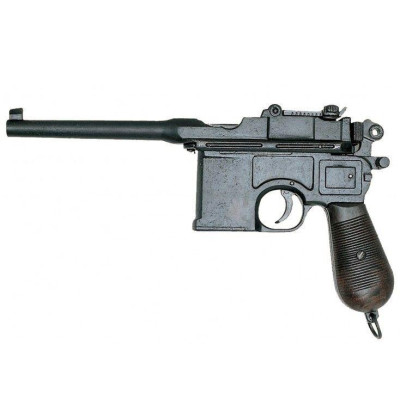
Mauser automatic pistol replica, size 7-63 mm, 1898. Wooden handle.