Active filters

Leather Boot  - 1

Leather Boot

€85.68
Availability: Out of stock

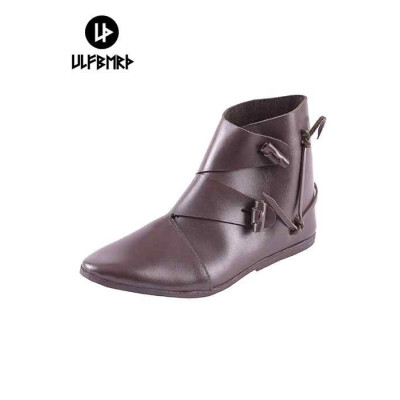
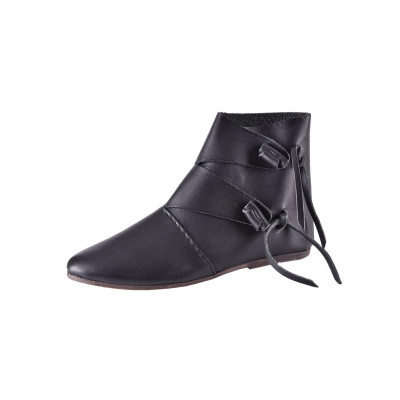
Very solid front ankle boots. Each boot has two shoelaces for fixing to the side.

Similar shoes were worn from 1250 to 1500 AD.

The sizes are normal, but the shape is narrow, especially on the fingers.

We recommend choosing a larger size if you want to have space or if your feet are wide.

Leather Boot  - 1

Leather Boot

€107.10
Availability: 5 In Stock

The closure of straps and buckles ensures a firm fit on the foot. The heel cover is reinforced for special use, the sole is fixed in a very stable nailing process.

Leather Boot  - 5

Leather Boot

€81.60
Availability: 5 In Stock

These ankle boots are based on archaeological finds in the city of York in northern England, the ancient Jorvik. They are dated between the 9th and 10th centuries, period in which England was divided into several smaller kingdoms. The Anglo-Saxon people had to defend innumerable Viking incursions. Many Danes established in England and York were conquered and ruled for about a hundred years by the Nordics.

As these shoes perfectly match the weather and place, of course you can call them Viking shoes. The ankles have a very characteristic closure: Two laminated leather lever buttons, which could be easily replaced by pins or horns.

Leather Boot with Buckles  - 1

Leather Boot with Buckles

€85.68
Availability: 5 In Stock

Medieval buckle shoes with buckles

A pair of buskins in the late medieval style, made of light brown leather. Comparable models were found in excavations, for example. in Constance.The shaft above the buckles can be used up or handcuffed down. The middle strap, all equipped with contemporary buckles, goes around the ankle, providing a firm hold. The sole and flat heel are attached by nails and very stable. With regular care, these shoes will remain intact for a long period.

Roman sandals, caliga  - 1

Roman sandals, caliga

€96.39
Availability: 1 In Stock

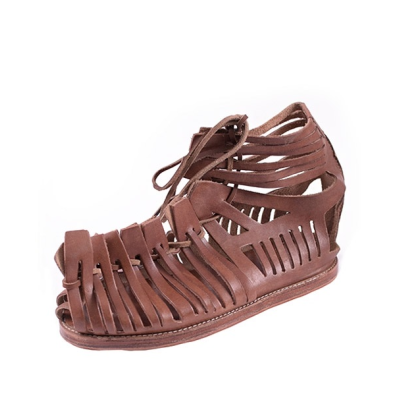
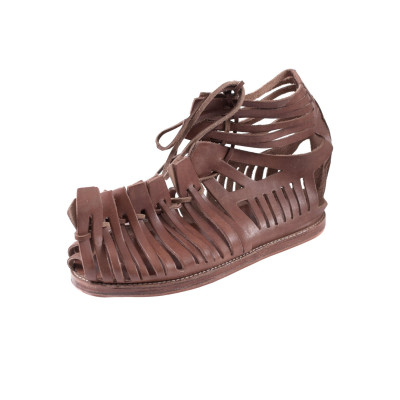
Roman sandals, caliga, light brown

These sandals were worn by Roman legionaries and peasants.

- 3 mm thick leather

- pleated leather bead

- Color: brown

Various sizes available.

Medieval Leather Shoe  - 1

Medieval Leather Shoe

€53.55
Availability: 1 In Stock

Shoe with front closure, late afternoon Shoe with front closure, late afternoon Shoe with front closure, late afternoon Shoe with front closure, late Middle Ages

Shoe with front lace, medieval afternoon

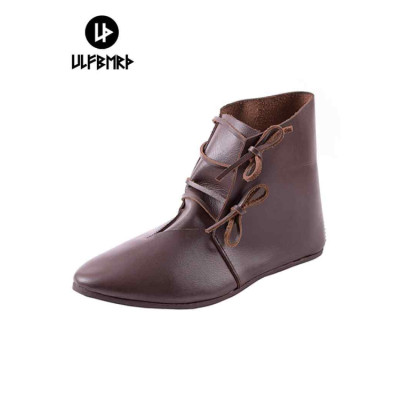
Sturdyreconstruction of shoes from the late Middle Ages found in London and dated

around 1380 AD Each shoe has three laces for fixation on the instep.

Leather Boots  - 1

Leather Boots

€149.94
Availability: 10 In Stock

Medieval boots tardías Medieval boots tardías Medieval boots tardías

Medieval boots tardías

Una bota de vástago elaborately elaboratese un patrón medieval tardío hecha de piel de vaca resistente y gruesa. El eje sube hasta debajo de la rodilla y tiene un puño cosido, que también cubre la rótula. El cierre de triple correa garantiza un ajuste firme, la suela se fija con clavos para una larga durabilidad y estabilidad.

Ankle boot with buckles, dark brown  - 2

Ankle boot with buckles, dark brown

€81.60
Availability: 9 In Stock

Ankle ankle ankle ankle stools, from high to late Middle Ages Medieval ankle ankle tins

with brass straps and buckles. These shoes were very common among medieval soldiers from 1250 to 1500 AD.

Roman women's shoes, Calcei, 2nd century  - 1

Roman women's shoes, Calcei, 2nd century

€101.75
Availability: 10 In Stock

Reconstruction of Roman shoes, the so-called calcei , which is believed to have been worn by noble Roman dames.

The original was found in a well near Welzheim (Germany) along with more shoes. These shoes date from the mid-2nd century to the early 3rd century AD. Around the end of the 2nd century, a young woman was found buried in the French village of Martres-de-Veyre in a woolen tunic, long socks and very similar shoes.

Jorvik Medieval Viking Shoes, Black  - 1

Jorvik Medieval Viking Shoes, Black

€107.10
Availability: Out of stock

These ankle tins are based on archaeological finds made in the city of York in northern England, the ancient Jorvik. They are dated from the 9th to 10th centuries - a time when England was divided into many smaller kingdoms. The Anglo-Saxon population had to fend off constant Viking attacks, and many Vikings settled in England. York was also conquered by the Danes and ruled by the Nordics for about a hundred years.