Large Tankard/Beer Mug, Genuine Vegvísir Horn This generously sized mug/tankard with handle is handmade from cattle horn, polished and adorned with an engraved vegvísir framed by a rune sequence.
The vegvísir (path finder) is a magical symbol or a so-called secrecy (galdrastafir) of Icelandic origin. A real representation of this symbol first appears in Geir Vigfússon's Icelandic Huld Manuscript of 1860, a collection of runes/spells and secrecies. It says:
If this signal is charged, the person will never lose his way in storms or bad weather, even when the path is not known.

(editar com o módulo Customer Reassurance)

(editar com o módulo Customer Reassurance)

(editar com o módulo Customer Reassurance)
Although vegvísir is often referred to as a "Viking compass" today, there is no evidence that it was actually used by the Nordics in the Viking Era (a good 8 to 10 centuries before the manuscript was written). However, it remains a significant symbol today. While heathenry adherents, also known as Germanic neopaganism, interpret it as a representation of the nine worlds of Norse mythology, it is often used in modern everyday life (e.g., in the form of a pendant or talisman) as a symbol of orientation in the figurative sense, intended to help its wearer cope with the storms that life brings along the way, even in unknown paths.
The rustic and highly decorative container we offer here is not only ideal for re-enactment purposes, but also for everyday use. Whether in a medieval setting or in a modern house, it will be a real draw at any dining table.
For hygiene reasons, the drinking glass is sealed inside with a secure varnish so you can enjoy your favorite beer (or mead) to the fullest.
A great gift idea!
Details: - Material: genuine cattle horn (buffalo)
- Engraved with a vegvísir with runes
- Height: approx. 15 cm
- Weight: approx. 350 to 450 g
- Operating capacity:
approx. 650 to 800 ml *
The mug is not calibrated and is therefore intended for private use only.
Horn mugs are not suitable for dishwashers and should be thoroughly cleaned before first (and after each) use with warm water and a soft cloth. Do not use aggressive cleaning agents that may damage the protective coating.
Dagger or Roman pugio. Zamak handle with gold-plated engravings hand decorated with blue and red glazes. Stainless steel blade with gold and black engraving.
Medieval armor on an approximate scale of 1:3 (71 cm high). Made of steel Includes sword and wooden support.
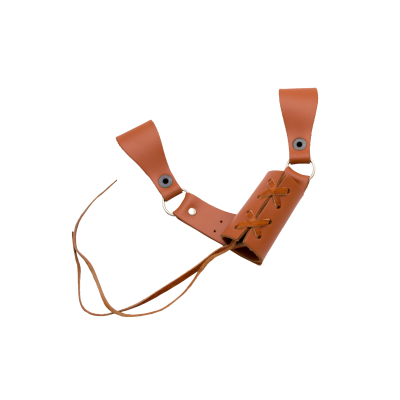
Tahalí for the sword made of leather to wear hanging from the belt.
Éomer was captain of the king's cavalry, Marshal's marshal, and one of Rohan's mightiest warriors. He fought bravely alongside King Theoden against the forces of Mordor at the battle of Helm's Deep and in the Pelennor Fields to protect the white city of Minas Tirith and the hope of all Middle-earth. When the Haradrim army attacked from the heights of their great war beasts, the Mûmakil, Éomer led a charge against them. He struck down two of the beasts with a throw of his powerful spear. This authentically detailed replica is a reproduction of the actual filming prop built by Weta Workshop and used in the "Lord of the Rings" films presented by New Line Cinema. The 84" long boom is crafted from wood and cold-cast steel in reinforced polyresin, with precision-molded details and coloring. It is presented with a polyresin wall display, carved in the iconography of the horse of Rohan, and includes a certificate of authenticity. The boom comes in two sections that are easy to assemble.
Details: Total length: 213.36 cm
Material:
wood and steel
Cold Cast Reinforced Polyresin Including Polyresin Wall Exposure
Dark Drake shoulder plates (steel), pair
Dark Drake shoulder plates are made of 1 mm thick steel with rivets and without sharp edges to make them safe for LARP weapons.
The leaf-shaped spearhead was a recurring drawing throughout the history of the spear. Used for hunting and war already in the Bronze Age, it came in the most varied styles in many eras and cultures - from celts to ancient Romans and Greeks to vikings - and continued to serve to the middle. Ages.
Functional sword with a total size of 97.5 cm with scabbard and 88 cm without scabbard, 1065 carbon steel blade, leather handle and scabbard with synthetic leather finish with belt for use.
Category: Cat.B
Overall size: 97.5 cm
Blade size: 69.5 cm
Blade thickness: 5.4 mm
Support: No
Weight: 1745 gr
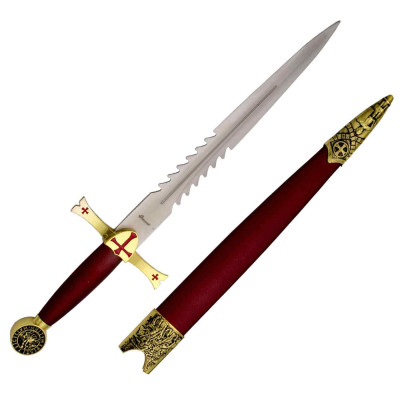
Flamboyant Templaria Daga gold crosses with Templar button designs and Knights Templar. With stainless steel blade and handle in zamak and ABS.
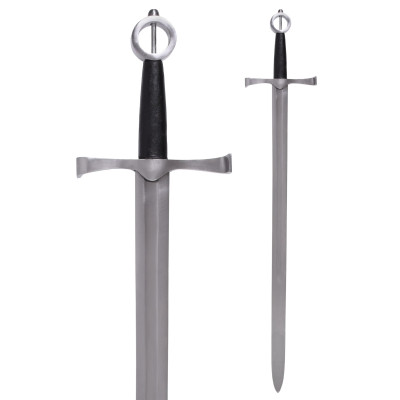
This one-hand sword is based on several original finds and 16th-century drawings of kerns (ceithern), the light infantry men who constituted most of the Irish forces in the late Middle Ages and the Renaissance. These Gaelic warriors, mainly mercenaries, proved their ferocity in many conflicts in the British Isles.
This loose-cut dress has slightly burned 3/4 sleeves and so-called cuts on the sides, extending from waist to hem. Gores, wedge-shaped/triangular-shaped pieces added to expand the shape of a garment, gave medieval clothing a generous touch.
It was designed as an ancient medieval exterior piece, as clearly show the contrasting details of the colors (its most notable feature). The collar is equipped with a button and a slit clasp in the center of the back.
The dress is made of plain cotton fabric and looks best worn with a leather belt.
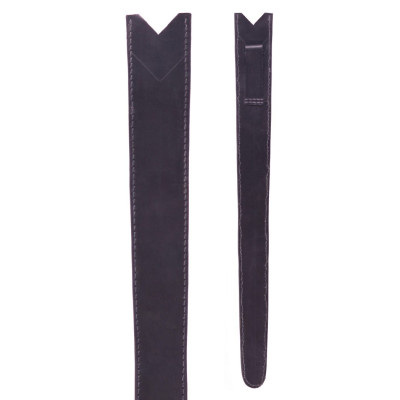
Sturdy leather sheath with belt clip
for hand and half training sword Nr. 0101024711
Details
- Length: approx. 79 cm
- max. Blade width: approx. 6 cm
- Leather thickness: approx. 3 - 3.5 mm
- Weight: approx. 0.5 kg
Elizabeth I of Castile and Ferdinand II of Aragon married in Valladolid in 1469, producing the dynastic union of Aragon and Castile, and is considered the beginning of the unity and greatness of Spain.
The Wars of the Roses, fought between 1455 and 1485, were a series of battles for the English crown between the Houses of York and Lancaster. Both families were members of the same European royal dynasty, the Plantagenets, who ruled England for the past three centuries. These civil wars (punctuated by brief episodes of relative peace) owe their name to the respective emblem of rival families, a white rose for Yorkers, and a red one for the Lancastrians. After 30 years of political plots and terrible bloodshed, the family dispute led to the end of the Plantagenet dynasty and the rise of the House of Tudor.
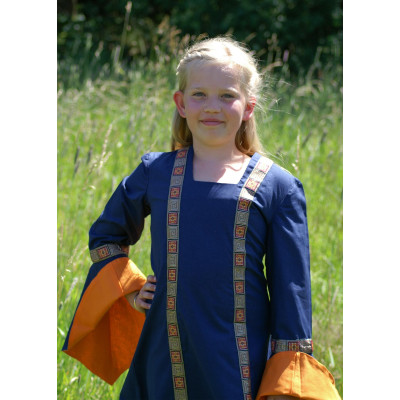
Beautiful bicolor children's dress. The main color is blue and an elegant edge decorates the front. The enlarged sleeves are lined in a different color. This dress draws attention when the sleeves are raised. The loop at the back provides a perfect fit.
Medieval velvet Kirtle / Cotehardie Isabell, long sleeves, red
This medieval velvet or kirtle dress has a tight bodice and an in-line skirt. The skirt piece is equipped with so-called gores (triangular/wedge-shaped pieces of fabric) that provide a generous touch and oscillate very well as you walk.
Large Tankard/Beer Mug, Genuine Vegvísir Horn This generously sized mug/tankard with handle is handmade from cattle horn, polished and adorned with an engraved vegvísir framed by a rune sequence.
The vegvísir (path finder) is a magical symbol or a so-called secrecy (galdrastafir) of Icelandic origin. A real representation of this symbol first appears in Geir Vigfússon's Icelandic Huld Manuscript of 1860, a collection of runes/spells and secrecies. It says:
If this signal is charged, the person will never lose his way in storms or bad weather, even when the path is not known.