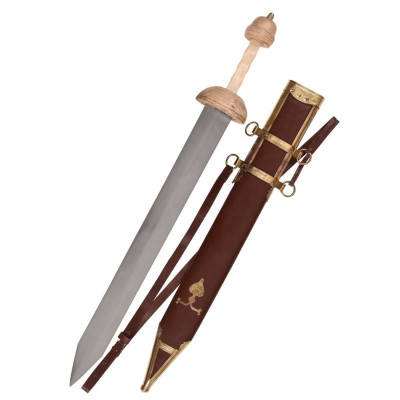
Roman spatha with sheath, 3rd century
From the 3rd century, the Romans adopted the long, straight double-edged swords of the Germanic people: the Spathae.
This replica is a reconstruction of a 3rd century AD spatha. The blade was forged from steel. The fist is made of bones. The wooden handle is covered with red leather and completed with authentic brass accessories.

(editar com o módulo Customer Reassurance)

(editar com o módulo Customer Reassurance)

(editar com o módulo Customer Reassurance)
Details:
- Total length: approx. 85 cm
- Blade length: approx. 63 cm
- max. Blade width: approx. 5.3 cm
- Cutting edge: approx. 2.4 mm
- Weight with sheath: approx. 1.9 kg
Replica of the Roman sword Gladius Pompeii decorative. Carbon steel blade, protection and handle on wood and lumbar bone. Includes wooden sheath with metallic finishes.
Containing all the features expected from the swords in the series, the Wasteland Gladius design emerges from the larger gladius designs with a pronounced "wasp waist" or "leaf blade" curvature. The long handle allows for easy use of the sword with one or two hands, making the Wasteland Gladius probably one of the most versatile swords in the series. The black textured fiberglass sheath is fitted to a Molle-compatible kydex platform that allows you to attach your swords to your belt or pack them in various carrying positions. The platform has four slots for belt or sling carry configurations.
Roman Fulham Type Gladius with sheath, 1st .C., sword decoration
The gladius, the main weapon of the Roman legionaries from 3rd c. BC to the 3rd c. AD, has been used in many variations over the centuries. Primarily designed as a storage/stab gun, it was also quite effective at cutting or cutting. Eventually, this highly feared short sword was gradually replaced by the longest spatha during the mid/late Roman Empire.
Epic Armory's Spatha is a LARP foam gun made of composite materials in the new hybrid method.
The shape of the Spatha dates back to the 1st century BC and lasted until the late Middle Ages Earls around 1050 AD.
Adopted from Celtic auxiliaries, The Spatha found its way into the Roman army and dissolved the Gladius around 200-300 AD.
The sharp blade of United Cutlery's Combat Commander Thai Nagi sword is made of high-carbon 1065 steel and has a hard black finish finish. The handle is nylon fiber and is as sturdy as possible!
Delivery includes a nylon sheath with a shoulder belt for easy transportation.
Details:
- Blade material: 1065 high carbon steel with black hard coating
- Cable material: nylon fiber
- Total length: approx. 101.6 cm
- Blade length: approx. 50.8 cm
- Includes nylon sheath with shoulder belt
- Manufacturer's product number: UC3142
Gladius Sword, training sword made of polystyrene designed for intensive practice, with an overall size of 81 cm and a blade size of 59 cm, with a black finish.
Overall size: 81 cm
Blade size: 59 cm
Blade thickness: 11.8 mm
Cape: Wired
Weight: 60 gr
Support: Unsupported
Spatha, Late Roman Sword with Scabbard, 2nd Century / III DC
This Spatha is not an individual replica of a real historical piece, but a reconstruction based on several original finds from the 2rd and 3rd centuries.
THE USGladius® knives are based on the design of the Roman Gladius (short sword), the standard weapon of the Roman Legion, proven on battlefields and the gladiatorial spectacles of the arena for over 400 years. This unique design not only provides excellent balance from the functional point of view, but also an unusual aesthetic beauty in a standard tactical knife.
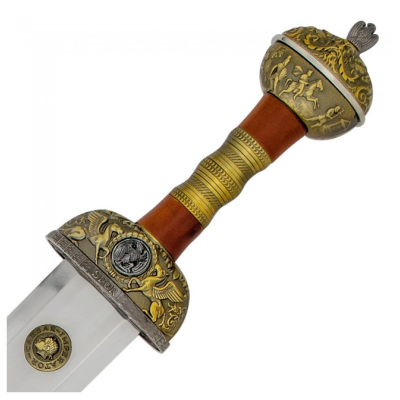
Gladius sword of Emperor Julius Caesar. Includes hem.
One of the weapons with which legionnaires conquered the great parts of Rome from the then-known world was the Gladius. The different types are categorized primarily based on the blade or the site.
This sword (Latin Gladius) is of the Mainz type with a double-edged blade. It is extremely efficient for slash and sting techniques and was a dreaded melee weapon.
This replica has an EN45 spring steel blade, which is not sharp. The handle and button are made of wood.
The hem is made of leather and has exquisitely decorated brass ornaments and metal plates, which show the Roman emperors Augustus and Tiberius, and wear rings on the sides of the hem.
Roman cavalry sword Spatha, finished in nickel on the handle, guard and handle. With a total size of 80 cm, steel blade with imitation apricot. Black Continene cover lined in brown synthetic leather with nickel details.
Total size: 80 cm
Sheet size: 50cm
Blade thickness: 3 mm
Gladius sword of Emperor Julius Caesar. Does not include hem.
Roman sword Spatha cavalry, with antique gold finishes on the handle, guard and fist. With a total size of 80cm, steel blade with imitation apricot. Black Continene cape lined in red synthetic leather with antique gold details.
Total size: 80 cm
Sheet size: 50cm
Blade thickness: 3 mm
Replica of a Roman Gladius, as carried out by the Roman legionaries around the time of Christ's birth.
Pommel and guard are made of beautiful wood. The handle is made of genuine animal bone. Steel blade and pommel are screwed together.
The sword comes with a wooden sheath with brass ornaments.
An introductory model accessible, but quite suitable for Roman re-enactment.
Gladius sword of Emperor Julius Caesar. Does not include hem.
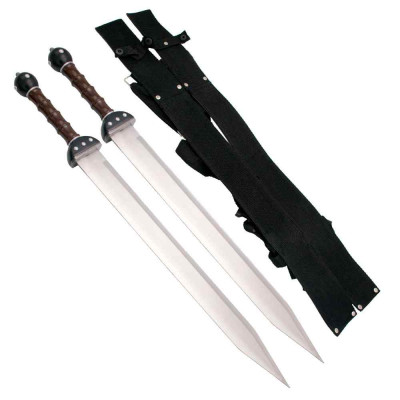
2 Gladius swords, fancy type including nylon sheath and drawstring to hang on the back.
Roman spatha with sheath, 3rd century
From the 3rd century, the Romans adopted the long, straight double-edged swords of the Germanic people: the Spathae.
This replica is a reconstruction of a 3rd century AD spatha. The blade was forged from steel. The fist is made of bones. The wooden handle is covered with red leather and completed with authentic brass accessories.