Replica of the Roman sword Gladius Pompeii decorative. Carbon steel blade, protection and handle on wood and lumbar bone. Includes wooden sheath with metallic finishes.

(editar com o módulo Customer Reassurance)

(editar com o módulo Customer Reassurance)

(editar com o módulo Customer Reassurance)
| Long | 73 cms. |
| Material | Blade: carbon steel |
| Long leaf | 52 cms. |
| Weight | 1.2 kg |
This General Maximus Sword is made of a high-carbon, hand-forged steel blade. It has a wooden and brass handle with a very detailed work and a handle in the color of the bones.
Includes sheath and baldric.
Roman Mainz Type Gladius with sheath, 1st century .C., sword decoration
The gladius, the main weapon of the Roman legionaries from 3rd c. BC to the 3rd c. AD, has been used in many variations over the centuries. Primarily designed as a storage/stab gun, it was also quite effective at cutting or cutting. Eventually, this highly feared short sword was gradually replaced by the longest spatha during the mid/late Roman Empire.
Gladius Roman dagger decorated with magnificent finishes. stainless steel sheet prints. Pomo and spares also include Roman allegories. 38 cms. Includes leather hem.
Roman Fulham Type Gladius with sheath, 1st .C., sword decoration
The gladius, the main weapon of the Roman legionaries from 3rd c. BC to the 3rd c. AD, has been used in many variations over the centuries. Primarily designed as a storage/stab gun, it was also quite effective at cutting or cutting. Eventually, this highly feared short sword was gradually replaced by the longest spatha during the mid/late Roman Empire.
The Roman Gladius is perhaps the most well-known piece of ancient weaponry. It is a simple and long blade, with a double edge and a long tip, making it a Ideal weapon for stabbing or piercing that could defeat the armor of its era.
Cold Steel's® interpretation is not a reproduction of a specific ancient Gladius, but is a collection of the main features of this venerable sword. The blade, for example, has the traditional shape, but, unlike the old version, it is made of high-carbon steel with spring tempering. It is fully sharpened on both edges and has a fine mirror polish. The tip is long but sturdy enough to resist bending or breaking. It also has a rosewood handle, carved and decorated in a classic style.
The wooden scabbard is covered in black leather and accented with a throat, cape and carry rings made of solid brass.
Details:
- Roman Gladius
- Blade material: High carbon steel
- Total length: approx. 71.1 cm
- Blade length: approx. 50.8 cm
- Blade thickness: approx. 8 mm
- Cable length: approx. 20.3 cm
- Weight: approx. 1.2 kg (incl. sheath approx. 1.6 kg)
-Incl. sheath
- Cold Steel® Product No.: CS-SW-RMNGLD
Replica of a Roman Gladius, as carried out by the Roman legionaries around the time of Christ's birth.
Pommel and guard are made of beautiful wood. The handle is made of genuine animal bone. Steel blade and pommel are screwed together.
The sword comes with a wooden sheath with brass ornaments.
An introductory model accessible, but quite suitable for Roman re-enactment.
One of the weapons with which legionnaires conquered the great parts of Rome of the world known at that time was the short sword. The different types are categorized primarily based on the blade or the site.
This sword (Latin Gladius) is of the Mainz type with a double-edged blade. It is extremely efficient for slash and sting techniques and was a dreaded melee weapon.
This replica has an EN45 spring steel blade, which is not sharp. The cable is made of wood and bone.
The ornate sheath is made of leather-wrapped wood, which features fittings made of brass and laminated metal.
A leather strap, attached to the transport rings, ensures a comfortable carriage of the sword.
The Sword of Julius Caesar with leaf, cross and button with details in Damasceno embedded in gold. It's a LIMITED EDITION.
Roman Spatha, long sword with scabbard, 2nd .C., decorating sword
This spatha is not an individual replica of a real historical piece, but a reconstruction based on original discoveries from the end of the 2nd century now maintained at the Limesmuseum in Aalen (Baden-Württemberg, southwestern Germany).
Final Roman Sword (Spatha)
Beginning around the 3rd century, the Romans began to adopt the long double-edged swords called Spathas,
which were originally used only against the Germans.
This replica is a reconstruction of a 4th century spatha.
The handle is carved into animal bone. The blade has two fullers.
The delivery includes a leather-wrapped wooden sheath with an authentic brass ornamentation.
Thrax Gladius Sword United Cutlery Combat Commander
Epic Armory's Spatha is a LARP foam gun made of composite materials in the new hybrid method.
The shape of the Spatha dates back to the 1st century BC and lasted until the late Middle Ages Earls around 1050 AD.
Adopted from Celtic auxiliaries, The Spatha found its way into the Roman army and dissolved the Gladius around 200-300 AD.
Gladius Launcher
Designed by Cold Steel President Lynn C. Thompson, the Gladius Thrower features a one-piece hardened steel blade with a wide Roman point. Its excellent weight and balance make it an excellent launcher even over long distances.
Designed to stick with its sturdy stitch or tapered butt, the Gladius Thrower makes a fun and unusual sport launcher. Flinging and hitting a satisfying, it will certainly be an unusual and much-talked about addition to any collection of knife throwers.
Details:
- Material: Steel S50C
- Total length: approx. 35.6 cm
- Blade length: approx. 21 cm
- Blade thickness: approx. 5 mm
- Handle length: approx. 14.6 cm
- Weight: approx. 303 g
Gladius sword of Emperor Julius Caesar. Does not include hem.
Gladius sword of Emperor Julius Caesar. Includes hem.
Roman writing board made of wood and wax with bronze writing utensil (Dyptichon).
Measurements
- Height: Approx. 20 cm
- Width when closed: approx. 12 cm
- Width when open: approx. 24 cm
- Weight: Approx. 0.4 kg
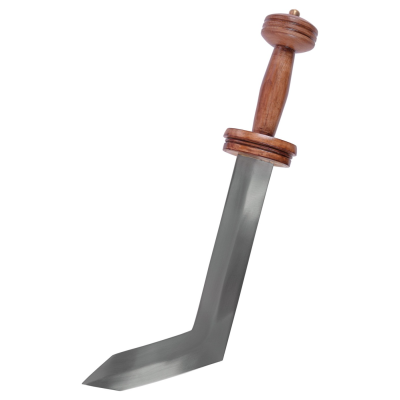
The sica was a curved dagger on one side, with thrakian-illirian origin. In Rome, the sica was mainly used by gangs of thieves, who were called sicarii. This weapon was also used by the thraeces, a special type of gladiator.
This reproduction of a sica features the classic curved blade, which is made of en45 spring steel. The blade is not sharp.
The handle, with handles and guard are made of skilled crafted wood. A brass plate has been inserted into the guard to ensure safety.
Replica of the Roman sword Gladius Pompeii decorative. Carbon steel blade, protection and handle on wood and lumbar bone. Includes wooden sheath with metallic finishes.