

Bokken ("wooden sword") is the Japanese term in kenjutsu for a wood-shaped katana. Used to train samurai in feudal Japan, it is now used as a training weapon in various Japanese sword arts. Some other martial arts (and all pedants) call it bokuto ("wooden sword").
A suburito is a bokken designed for suburi. Suburi, literally "naked cut," are solo cutting exercises. Suburito are thicker and heavier than regular bokken, so you need to develop good technique, strong muscles, or both to wield one. Their weight, however, tends to make them poorly balanced, consequently they are not used for pair practice.
Miyamoto Musashi was famous for his use of the bokken in actual combat.
Details:
Total length: 98.5 cm
Handle: 24.7 cm
Weight: 0.46 kg including tsuba

(editar com o módulo Customer Reassurance)

(editar com o módulo Customer Reassurance)

(editar com o módulo Customer Reassurance)
Set Composed by Katana,Wakizashi and Both with Support
The Gold Lion Wakizashi reflects the materials, fit and finish of its big brother (Gold Lion Katana, Product No. 88ABK) in all respects except size. It is equally light and fast, and with the same high quality materials, but in a fraction of the size, making it an excellent piece to accompany the Katana Golden Lion, or a beautiful standalone blade by itself.
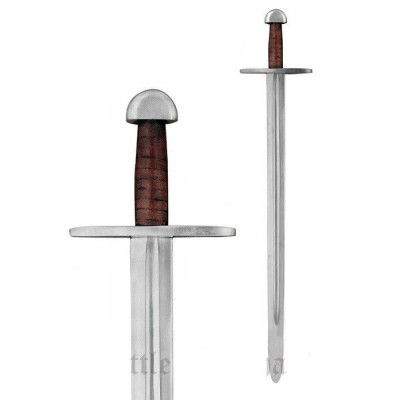
Normandy sword for hand forged practices with oil-hardened carbon steel blade and blunt tip. Handle covered with brown leather. It was used in the battle of Hastings in the year 1066 of the Normans against the English. Includes leather covered wooden sheath
Dagger with hem. With stainless steel blade.
Quiver made of brown leather
with back strap
- Height: approx. 60cm
Max. circumference: approx. 34 cm
- Leather thickness: approx. 3 mm
- Weight: approx. 0.8 kg
Medieval Tabardo, Knights Hospital, black / natural color
This calf-to-calf tunic is made of sturdy cotton fabric. It is cut straight and has side slits from the waist down, as well as slightly shorter slits in the center of the front and back. It presents on its chest the cross of the Hospitalries (cross of Malta).
These medieval hoses (also called chausses) are made of cotton fabric and equipped with laces with metal tips. They are cut into bias, which gives them a natural elasticity and greatly increases the comfort of use. Small side slits on the hems make it easy to put on the shoes. The appearance and cutting of these hoses can be historically attributed to the High Middle Ages.
Although the existence of pantyhose can be traced back to the Neolithic period, this type of legwear did not become popular until the Middle Ages, when more fittedclothes began to become fashionable. Worn exclusively by men and initially worn as underwear, they were tied to a belt or directly to pants with pointed laces. By the end of the Middle Ages, the cut had evolved further, so the pantyhose usually covered the buttocks and used to be worn with a gibbon. The Mi-Parti hose (also known as multicolored hose , divided - mainly vertically - in different colors) was also quite popular. Numerous illustrations testify to the prevalence of hose in the Middle Ages, for example, in the Rutland Psalter , an illuminated manuscript, and in the Morgan Bible (also known as Maciejowski Bible or Crusader Bible). ), an illustrated 13th-century Bible.
A symbol of power and strength for the proud Maasai people of East Africa is their elegant spear of war.
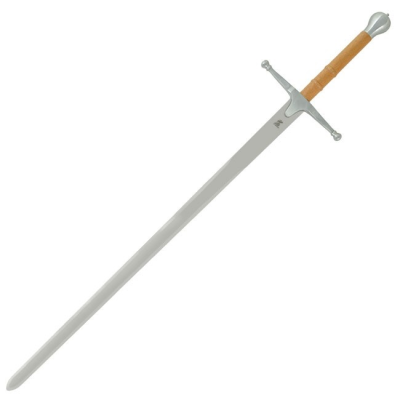
William Wallace sword with stainless steel blade.
Decorative flint gun, 19th century French. (Left hand). Made of wood and Zamak. Length .- 39 cm.
Replica of horse armor.
Excellent replica of horse armor from the collection "Equestrian Armor" manufactured by MARTO
Certificate of Origin and Quality
Viking Sword of Hedeby with Scabbard, 18th century. 9, Damascus Steel Blade
Sword used in the Crusades in the 12th century. It is ideal for recreationists who want to carry a medieval sword The Order of the Poor Knights of Christ (Latin: pauperes commilitones Solomonici Templique Christi)., commonly known as the Knights Templar or Order of the Temple (French: Ordre du Temple or Templars) was one of the most famous Christian military orders.
Bokken ("wooden sword") is the Japanese term in kenjutsu for a wood-shaped katana. Used to train samurai in feudal Japan, it is now used as a training weapon in various Japanese sword arts. Some other martial arts (and all pedants) call it bokuto ("wooden sword").
A suburito is a bokken designed for suburi. Suburi, literally "naked cut," are solo cutting exercises. Suburito are thicker and heavier than regular bokken, so you need to develop good technique, strong muscles, or both to wield one. Their weight, however, tends to make them poorly balanced, consequently they are not used for pair practice.
Miyamoto Musashi was famous for his use of the bokken in actual combat.
Details:
Total length: 98.5 cm
Handle: 24.7 cm
Weight: 0.46 kg including tsuba