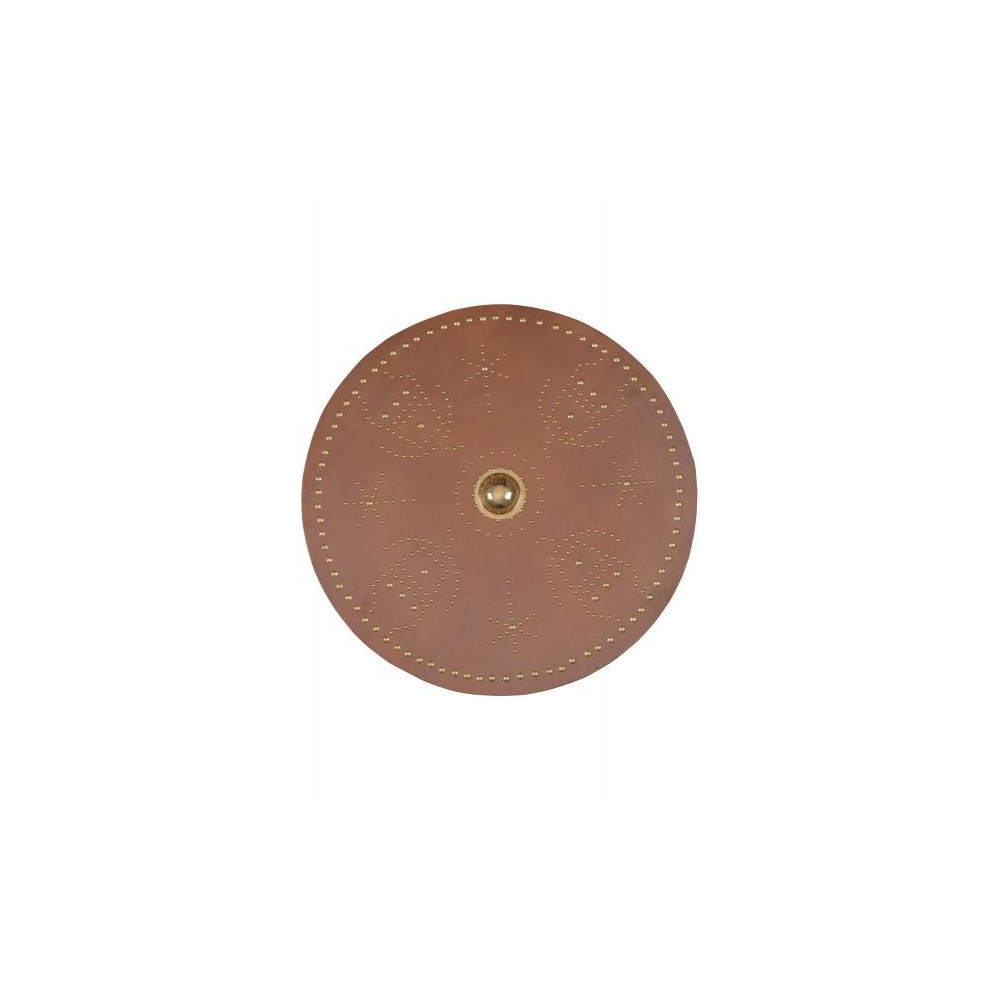



This replica of a Highland Targe is made of plywood and covered with leather. This round shell is elaborately adorned with decorative brass nails. It features a generously sized brass shield chief in its center.
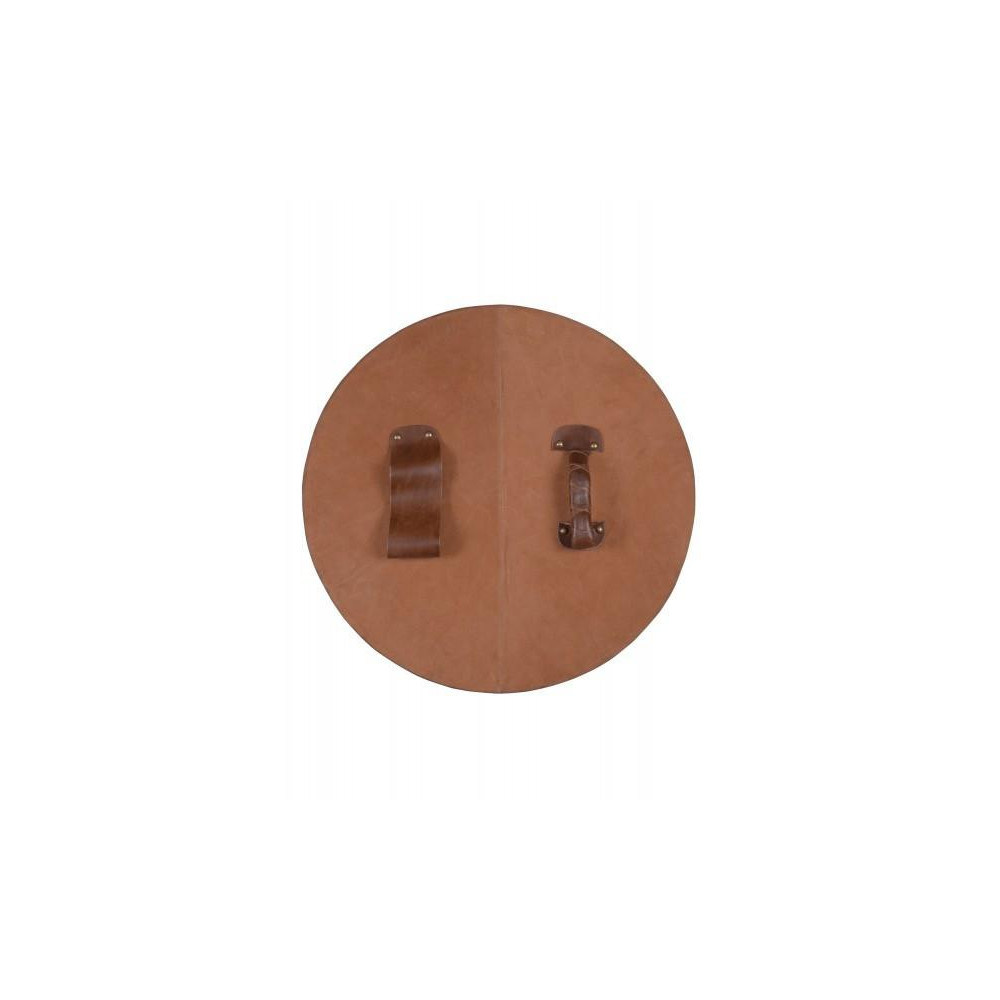
At the back of the suede-lined shell, the handle and arm strap, both leather, are secured with brass rivets.
Details:
- Material: plywood and leather, bossa and brass accessories
- Thickness: approx. 13 mm
- Diameter: approx. 63 cm
- Weight: approx. 3kg

(editar com o módulo Customer Reassurance)

(editar com o módulo Customer Reassurance)

(editar com o módulo Customer Reassurance)
Most likely, the original of our replica was made by him too, because it was "captured" at the Battle of Culloden in 1746 and taken to south London with the Jacobite prisoners. He's now at the Royal Weapons Museum in the Tower of London.
This excellent museum replica has a removable central tip that, if mounted, makes the shield become an evil weapon.
It features a bronze protrusion in the center, decorative brass rivets and beautiful Celtic ornaments engraved on leather. The targe is made with hand-dyed natural leather that is fixed by brass rivets.
Features:
- Material: Wood and leather
- Diameter: approx. 46 cm
- Thickness: approx. 1.7 cm
- Weight: approx. 2.2 kg
Gunpowder flask, ivory color, replica
This very decorative gunpowder flask or gunpowder horn is made of resin (imitation ivory) and metallic brass finish. It is adorned with an elaborate hunting motif and equipped with a carrying strap made of leather.
Please note that the jar has no opening and is designed exclusively as a collector's piece or decoration/display. It is also perfectly suited as a prop, for example, to complete your costume. When paired with a flintlock pistol or musket, it will make your character look even more authentic.
A beautiful addition to any firearm or muzzle collection and a must-have accessory for reenactors of the gunpowder era.
Details:
- Material: resin (faux ivory), metal (antique brass finish), bracelet
Leather - Dimensions: approx. 18 x 9 x 5 cm
- Weight: approx. 230 g
Specifications may vary slightly from part to part.
This is a reproduction of Thorin's Royal Sword seen in the Hobbit "The Battle of the Five Armies". The sword has a 440 stainless steel blade with engraving along it. It also comes with a richly decorated wall mount.
Details:
Total length: 93.5 cm
Blade length: approx. 71.5 cm
Handle length: approx. 12 cm
Weight: 1.9kg
Blade Material: Steel
Stainless 440 Handle Material: Alloy
Zinc Plate
wall:
Height: 29cm
Width: 21cm
Material: Wood
Blade size: 23.20 cm
Cable size: 14.00 cm
Overall size: 40.80 cm
Steel Type: 3Cr13Mov
Finish: Gloss
Blade thickness: 2.30 mm
Decorative use
Handle: Zamak/ABS
Viana: Zamak
Weight: 288.00 g
This type of Iron Hat was worn in Europe in the mid-15th century (1450).
Features:
Made of 2mm thick steel. Includes adjustment straps, leather.
Weight approx: from 2.40 kg to 3.30 kg
Available sizes:
M = Head circumference of 61 cm
L = Head circumference of 63 cm
2 Gold Shields minted in Seville (Doblon) Felipe II 1556-1598
Two inches.
Sword Cazoleta of Charles III in cadet size engraved and finished in rustic (steel tone). Blade in hardened stainless steel, forged and satin. Length 77 cm, weight 650 grams
This beautifully shaped fanny pack made of high quality bovine leather has a detailed engraving of a Thorshammer. The surface and edges are polished, giving the bag a high quality finish.
The central part of the body of the bag is made of matching suede (suede leather). The front panel is sharpened with hand-tied leather straps. A leather lever serves as a fastener.
Details:
- Material: vegetable tanned bovine hide.
- Width: approx. 14 cm
- Height: approx. 12 cm
- Depth: approx. 6 cm
- Weight: approx. 0.2kg
One Piece Katana Enma Zoro keychain, 22 cm, made of zinc and steel, with opening system served in blister pack.
Blade size: 15.0 cm
Total length: 22.7 cm
Weight: 80 gr
Being in the legion, you need protection from projectiles and blows without disturbing your vision or your breathing! After all, you legionnaires are well known for walking hundreds of miles on the empire road, from one battlefield to another, and walking miles has never been easy for those wearing a fully enclosed helmet.
The Roman helmet worn during the Empire is the product of a slow evolution of the first simple Italian bronze helmet to the Celtic-influenced helmet worn by the legionaries of Augustus, Trajan, Hadrian and all other famous Roman emperors.
The fact is that this remarkable helmet proves surprisingly versatile and strikes a perfect balance between protection and mobility. Just pair it with one of our lorica hamata and you'll get an ideal combination for your next LARP or reconstitution! A great look without harming your vision and freedom of movement.
This gorgeous helmet is handmade 18 gauge soft steel, lined with a comfortable and secure synthetic leather lining. A circumference of approx. 68 cm makes almost all head sizes fit. The historic crest attached to the top will make your Roman outfit stand out!
The original sword on which this replica is based is housed in the French Army Museum in Paris (Musée de l'Armée) and was made in Western Europe between 1300 and 1350, during a transitional period in medieval warfare when mail armor was still dominant but was gradually reinforced with additional plates.
Swords of this type were typically used in conjunction with a buckler or shield, making them versatile revolvers on both the battlefield and civilian level.
This particular sword is a faithful reproduction, carefully crafted to the exact measurements of the original. The leaf has a lenticular cross-section with a channel that ends at two-thirds of its length. The sword is classified as Type XIV due to its relatively short blade, with a sturdy, wide profile that tapers into a strong, sharp tip. This rigid blade is ideal for both cutting and stowing, while its considerable width makes it easy to lock and move the opponent's blade. While most Type XIV swords have curved guards and wheel knobs, this one features a straight guard (Oakeshott Style 2) and a spherical hilt topped by a protruding block. The added riveted button block has a practical function as it provides greater length to the tenon. This design feature makes it easy to disassemble or further modify the bar, ensuring its longevity and adaptability.
Its most distinctive feature is the brass button in the shape of a faceted sphere, with polyhedral faces. While it doesn't exactly fit a single type of Oakeshott, it is very similar to Type R pommels and is reminiscent of those seen later on basket-handled swords, such as those recovered from the sinking of the Mary Rose.
The sword is even more beautiful because of its details in its design. The combination of the red hilt and scabbard with the yellow brass hilt evokes the image of a high-ranking weapon, fit for a nobleman. This attention to detail extends to the brass cap, where the finial reflects the button, creating a cohesive and elegant design.
This is why he is called The Seneschal, le Sénéschal, (Chief or chief of the nobility, whom he ruled, especially in war or Butler of the Royal House) reflecting the authority and importance of a key figure in the medieval hierarchy.
SPECIFICATIONS:
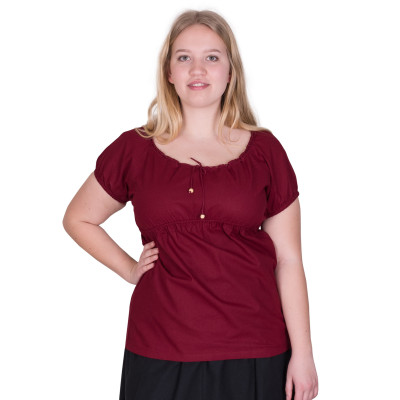
Medieval short sleeve Aren blouse
The medieval blouse is made of lightweight cotton fabric and has a loose cut. The neckline is decorated with fine cotton lace and can be adjusted in width by means of a thin drawstring. Elastic pleats just below the bust line and on the sleeve bar create a beautiful effect.
Viking Sword Godofada
Named for the dandy 8th-century Viking Godfred Haraldsson, this sword is built around a beautifully patterned folded steel blade to replicate the originals of the 9th century. The interlaced leather handle, complemented by an Apricot guard and pommel, is accompanied by a leather-covered wooden hem with brass detailing and full belt hooks.
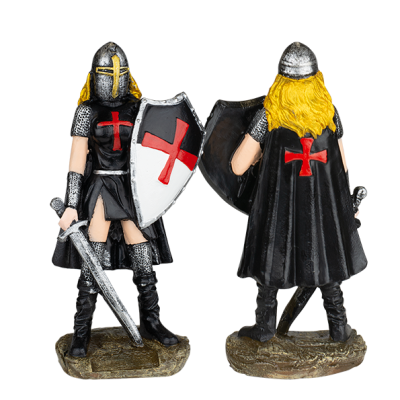
Resin figure of the Knights Templar, measures 12cms
Sten Mark submachine gun decorative standard II caliber 9mm, used by the United Kingdom in World War 2.
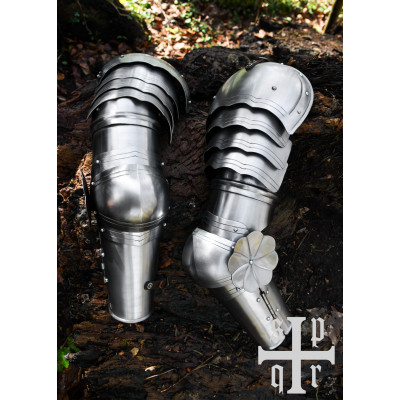
Complete Protection of Gothic Arm, Vambraces, Couters, Rebraces and Pauldrons of the Century
XVI Steel
This fully articulated, wearable reconstruction of a late medieval or rather Renaissance arm armour, used in the sixteenth century, is made of 1.6mm thick steel and blackened on the inside for better corrosion resistance. It is designed to protect the forearms, elbows, arms and shoulders.
Arm protection consists of a couter or cowter (also known as an elbow cop), a two-piece tubular (hinged) vamp or lower barrel for the forearm, a short tubular rerebrace or upper barrel for the arm, and a shoulder pad (sometimes spelled pouldron or powldron) to the shoulder. For proper freedom of movement, all parts are connected to each other by sliding plates or lames held in place by sturdy leather strips riveted inside. A strap buckle is riveted to the top edge of the shoulder plate, allowing the arm harness to be attached to a gambeson with braided ropes or connected to other pieces of the plate armor via leather straps.
Equally suitable for historical reenactment, LARP, stage, TV/film, or fantasy, these articulated arm guards will make your portrait of a proud knight perfect!
Sold as a pair.
Details:
- Material: 1.6mm steel, leather straps, brass buckles
- Total length: approx. 65 cm
- Inner diameter at arm: approx. 13 cm
- Inner diameter at wrist: approx. 8 cm
- Shoulder width: approx. 23 cm
- Weight (pair): approx. 6.5 kg
Specifications may vary slightly from part to part.
Please note:
To ensure that this armor is the right fit for you, remember to take your measurements on your gambeson and/or any garments or chainmail you may plan to wear underneath!
The steel used here is not rust-proof and may have slight surface stains in places. We recommend that you maintain plate armor regularly, for example by using the universal Ballistol oil, which is ideal for steel care.
This replica of a Highland Targe is made of plywood and covered with leather. This round shell is elaborately adorned with decorative brass nails. It features a generously sized brass shield chief in its center.
At the back of the suede-lined shell, the handle and arm strap, both leather, are secured with brass rivets.
Details:
- Material: plywood and leather, bossa and brass accessories
- Thickness: approx. 13 mm
- Diameter: approx. 63 cm
- Weight: approx. 3kg