To know from Charlemagne
The saber of Charlemagne the Great is a vital part of European history, being an important artifact in the insignia of the Holy Roman Empire, of which Charlemagne was the first emperor. The saber is now housed, along with the rest of the imperial insignia, in the Kunsthistorisches Museum of Vienna.

(editar com o módulo Customer Reassurance)

(editar com o módulo Customer Reassurance)

(editar com o módulo Customer Reassurance)
The sword is of Eastern European origin, dating from the first half of the 10th century. It is not known how he became part of the insignia, but his sumptuous decoration indicates that it was made for an important member of the nobility. It is clearly a cavalry saber, indicative of its origins in the steppes of Eurasia.
The cas saber version of Hanwei is faithful in detail to the weapon as it was conceived, to the point of omitting the decorative repairs of the 15th century that make the original unusable. The high-carbon blade features a large fuller with gold finish, with intricate recordings to match the original. The authentic handle construction features a handle wrapped in ray skin with a golden brass shield and accessories, including a global handle that balances the sword beautifully. The wooden core sheath is lined with leather and gold brass accessories to match the handle. Hem conveyor rings are suitable for belts or straps with a maximum width of 23 mm.
Made by Hanwei.
Main features:
- Fantastic details
- Well-balanced high-carbon blade
- Museum quality
Details:
- Total length: approx. 89 cm
- Blade length: approx. 71.1 cm
- Cable length: approx. 18.9 cm
- Weight: approx. 907 g As
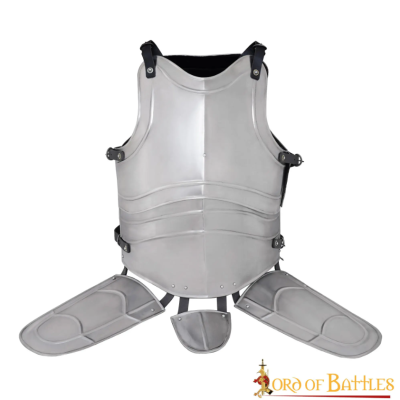
The base of these protections is made of soft steel sheet of 1.2 mm thickness with anti-rust finish. The applications on the back are in brass with patina finish.
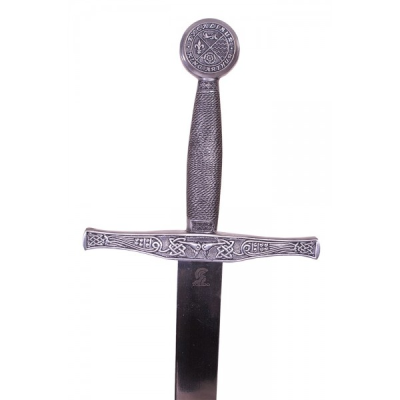
Sword Excalibur, the legendary sword of King Arthur.
This floor-length medieval dress is lightweight cotton. The skirt piece is equipped with side gums (triangular/wedge-shaped pieces of fabric), allowing for generous flare. It has a wide neckline, so as to remain hidden under the outer wear at the level of the neck. The sleeves feature a lace for individual fit. At first, quite tight on the arm, they fall into a particularly wide glare that gives them the characteristic shape of trumpet. This change can be used under a hood, a cotehardie or a bliaut.
Cid's tizona dagger with scabbard, guard and pommel with bronze details. With a total size of 40 cm, steel blade. Impressive in every aspect, this perfectly-sized sword is the essential weapon for lovers of history and historical replicas. The elegant scabbard, careful guarding and bronze detail on the hilt further elevate the quality and beauty of this sword. And with a strong and durable steel blade, this dagger is a useful and authentic tool for any collection. Get it and feel the thrill of carrying an authentic historical piece in your hands!
Overall size: 40 cm
Blade size: 24 cm
Blade thickness: 2.4 mm
Weight: 240 gr
Medieval decorative dagger with carbon steel blade and sheath with metal parts. The blade is 20 cms. Total length of 34.5 cms.
Cannon used by Napoleon's troops, manufactured by Gribeauval, 1806
The rapier was primarily a civil dueling sword since the sixteenth century.
This sword called "Pappenheimer" is characterized by a basket-shaped guard that protects the hand. Its name comes from Gottfried Heinrich zu Pappenheim, a field marshal of the 30 years' war. This Rapier Swept Hilt Basket features a non-sharp blade made of high-carbon steel, a sharp tip, and a wire-wound handle. The scabbard is made of leather-wrapped wood and has a metal throat and cover.
Details:
- Blade material: High carbon steel
- Total length: approx. 114 cm
- Blade length: approx. 92 cm
- Cable length: approx. 15 cm
- Weight: approx. 1600 g
Specifications may vary slightly from part to part.
Smooth pectoral for unengraving armor. It's not functional for people. The pectoral is part of the medieval armor and its mission is essential as it protects the fighter's vault.
The axe head on the Condor Valhalla Knife Axe and Tool is made of 1060 high carbon forged steel and is heat treated and seasoned with about 50-55 Rockwell hardness. The natural finish is a bare metal look that has the appeal of a pair of well-worn jeans. This finish is a perfect manual hammering process and gives a classic and enhanced look to an already well-made tool.
Excalibur sword with stainless steel blade, manufactured in Toledo (Spain). To choose with or without hem. The story and legend of King Arthur's Sword are closely linked to the magical and mysterious Sword Excalibur and, according to the wizard Merlin had announced, only anyone who could draw the sword from the rock would be king.
A very elaborate reconstruction of a beast used in the 15th century to defend the walls and towers of castles.
This medieval beast comes complete with a so-called English snowbox (equipment) and three screws with wooden rod and forged and blackened steel bodkin tip.
Katana One Piece Zoro Enma Katana unofficial replica with lilac leather finish, 101 cm steel blade with black finish with yellow and green cut details, with lilac leather hem with gold accents and red drawstring, lilac lilac leather handle with gold accents.
Forging pliers, approx. 27 cm
This forged flat nose pliers is the ideal tool for blacksmiths and craftsmen. The rustic pliers are the perfect accessory for medieval markets or camps.
Details:
- Length: approx. 27 cm
- Jaw length: approx. 5.5 cm
Observation:
The above specifications may vary slightly from part to part.
This is an original ULFBERTH® product.
Pendragon medieval sword model.
It is a sword belonging to the exciting tales of King Arthur and the knights of the round table. This impressive sword captures all the elegance of a sword worthy of a king. The blade is made of manually forged carbon carbon steel with the button and gold-plated protector. No hem.
Typical Italian Fashion Barbute Helmet about 1440 AD.
Made of elaborately crafted and riveted 1.6 mm steel.
To know from Charlemagne
The saber of Charlemagne the Great is a vital part of European history, being an important artifact in the insignia of the Holy Roman Empire, of which Charlemagne was the first emperor. The saber is now housed, along with the rest of the imperial insignia, in the Kunsthistorisches Museum of Vienna.