Hand-forged carbon steel halberd
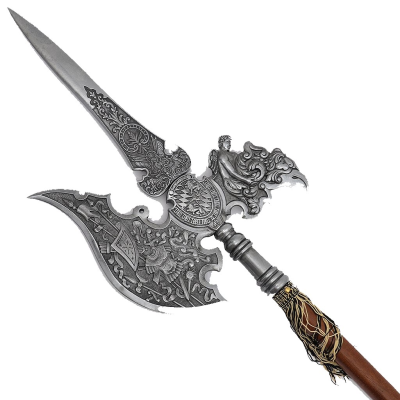
Halberd hand forged carbon steel.
Height: approx. 41 cm
Width: approx. 13 cm
Delivery includes rosewood shaft, screwed in the middle.
Length: approx. 180 cm
Active filters
Halberd hand forged carbon steel.
Height: approx. 41 cm
Width: approx. 13 cm
Delivery includes rosewood shaft, screwed in the middle.
Length: approx. 180 cm
The Halter is a wooden beam gun about two meters long, which has in its "head of arms" a spearhead like a top pectoral, a cross blade in the form of an axe blade on one side and the other pectoral punching or hooking smaller by its opposite.
Pike, polearm widely used by infantry, mainly to deal with cavalry attacks and charges.
Spears were first used by the ancient Greeks, in the famous phalanxes, which were large squares composed of rows of pikemen, called "foot companions". At the end of the Middle Ages, its use was reinvented by the Swiss, mercenaries valued for more than two centuries. At the beginning of the Modern Age, variants emerged, with the model of the Spanish Tercios being the one that prevailed.
Clearly defensive in nature, pike was used mainly in defensive or cover tactics: to avoid charges, slow down cavalry, or defend positions and positions.
The end of spears, at the beginning of the eighteenth century, occurred when the musket, more powerful than the arquebus, could carry a bayonet, serving as a spear in case of hand-to-hand combat. Changing power from firearms to spears.
Medieval spear of 22 cms. It corresponds to the end of the Middle Ages. Made of carbon carbon forged steel.
It corresponds to the beginning of the Middle Ages. Made of carbon carbon forged steel.
War Spear with ass tip
With a length of 203 cm and a rod of 2.5 cm in diameter, the Paul Chen War Spear has a distinct Viking ancestor and a frank style. The dragged head is balanced by a tail peak, providing the ultimate in sayming pieces.
Main features:
- forged steel head
- Wooden shaft
- Authentic design
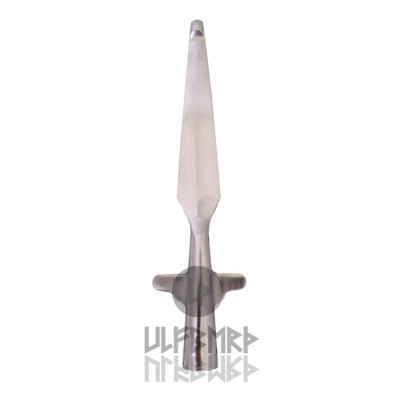
Typical Roman pilum (spear).
Made of hand forged steel.
Screwed in the middle.
Delivery includes rosewood shaft.
Measurements:
Total length: approx. 215 cm
Weight incl. Shaft: Approx. 2.2 kg
The Viking spearhead offered here displays the narrow, pointed blade designed to pierce the mesh. The Nordic warrior often carried several light-throwing spears in combat, loaded into the shield's hand on a charge. These were launched as the distance closed, leaving the warrior free to use his sword or axe in hand-to-hand combat.
- BATTLE-READY -
Very solid and hand forged cutting edge boom. Most reenactment groups allow the use of such round-bladed and thick blade-tipped spearheads on the battlefield. The mouth of the socket is well forged and closed. A hole is drilled into the steel to secure the shaft. This type of blunt spearhead is available in different sizes and designs.
Delivery does not include shaft.
Details:
- Total length: approx. 34.5 cm
- Blade length: approx. 21 cm
- Blade width: approx. 3-5 cm
- Blade thickness: approx. 3 mm
- Outlet length: approx. 12 cm
- Outlet diameter: approx. 3 cm (at the widest point)
- Weight: approx. 380 g
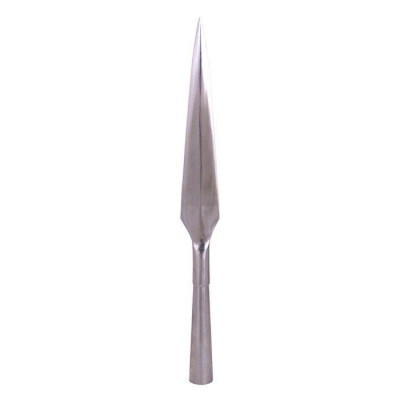
Hand forged carbon steel spear. Massive point!
These spears were especially suitable for piercing enemy armor.
Length: approx. 36.5 cm
Nozzle: approx. 30 mm
Additionally available:
Rosewood rod, screwed in the middle
Length: approx. 180 cm
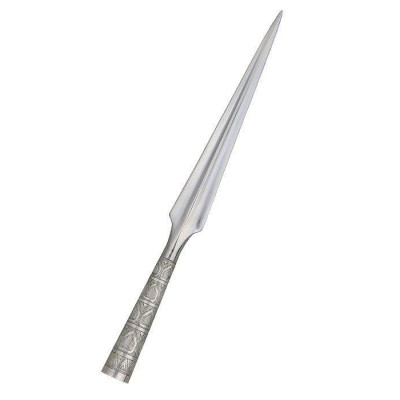
This reconstruction of a Germanic frame follows a Germanic find from the south of approx. 1 to 5 centuries a.d. The picture (lat. Framea) is a Germanic dart similar to the ango spear.
It differs from germic ger ger however. Tacitus (Germania 6) describes the equipment of the Germanic warrior as follows:
in Damascus Steel.
Germanic framea, sharp, approx. 24cm
This reconstruction of a Germanic frame follows a Germanic find from the south of approx. 1 to 5 centuries a.d. The picture (lat. Framea) is a Germanic dart similar to the ango spear.
check_circle
check_circle