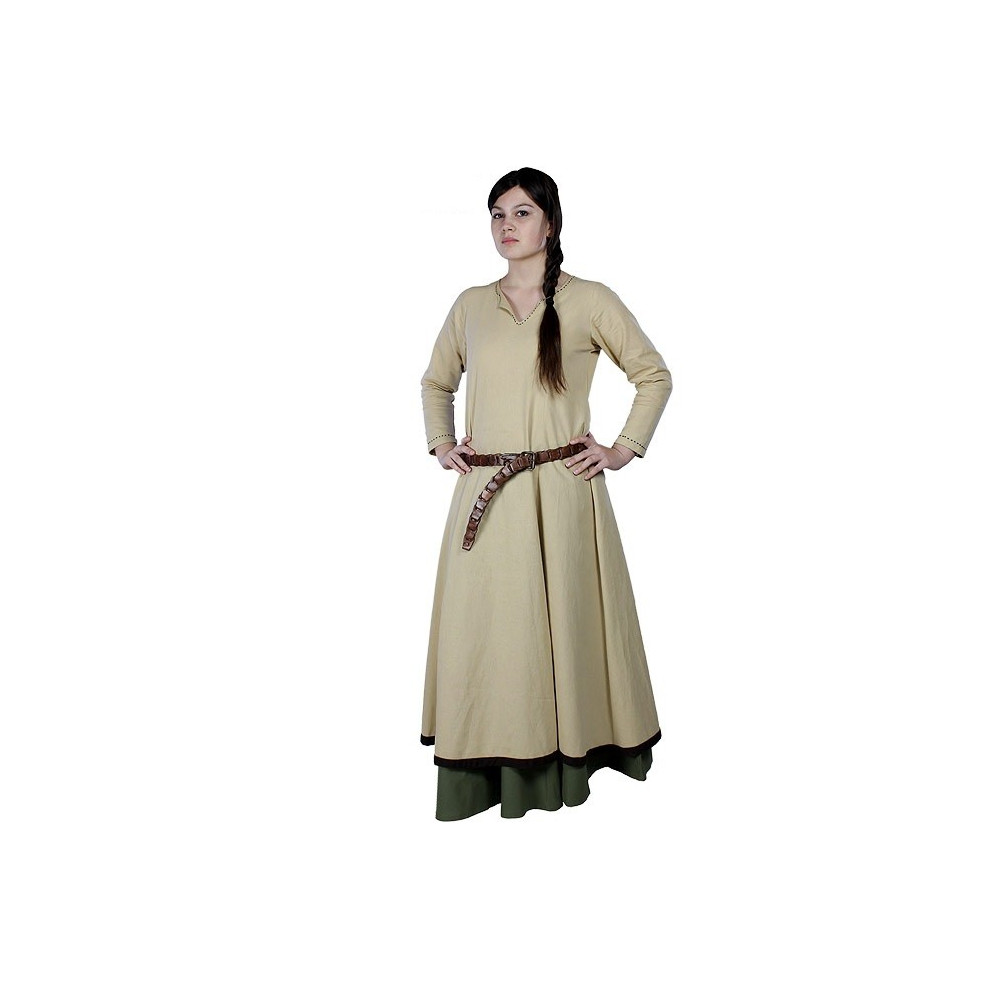


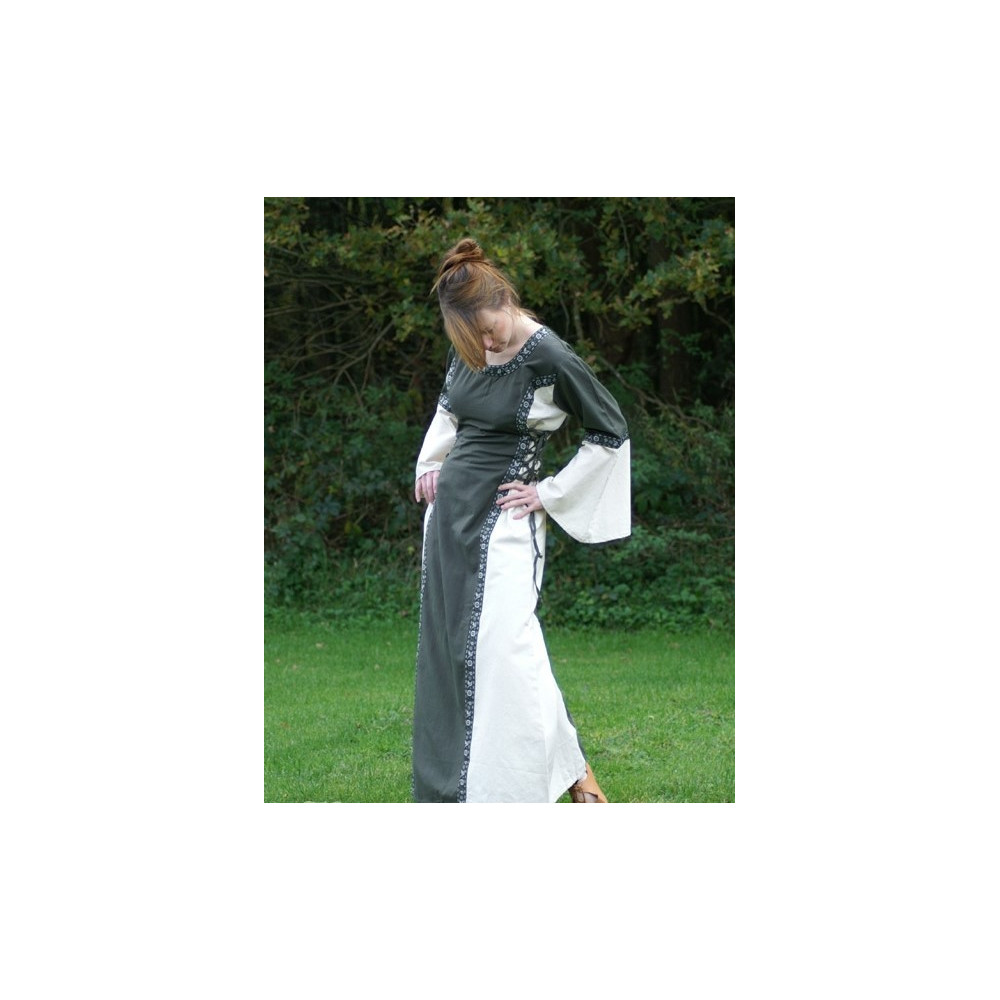

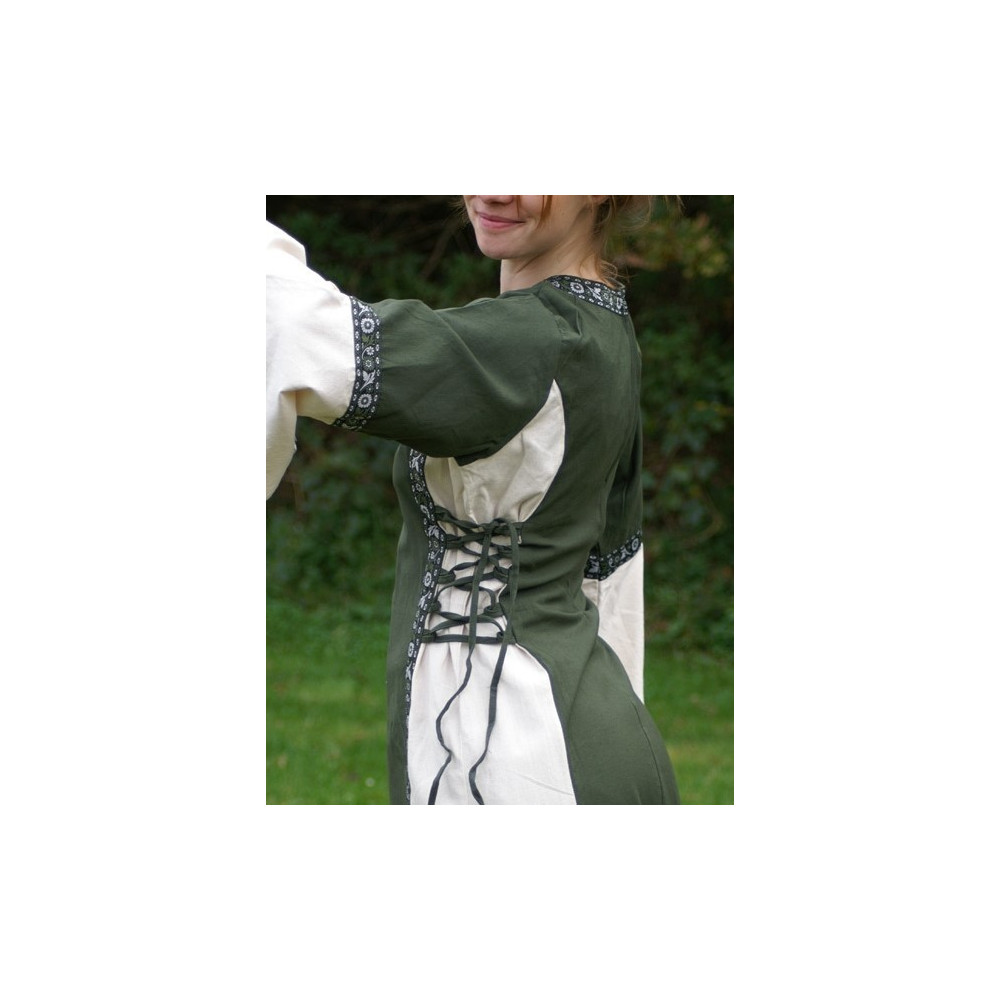


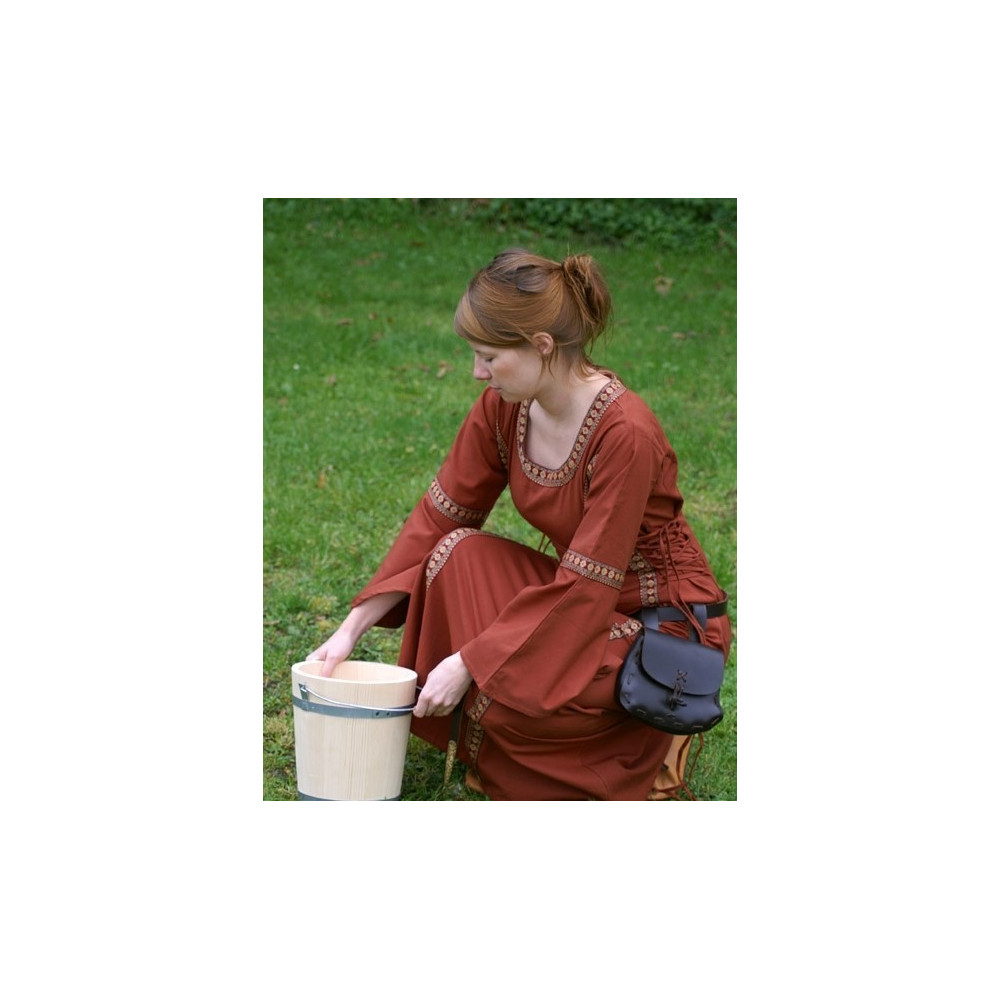


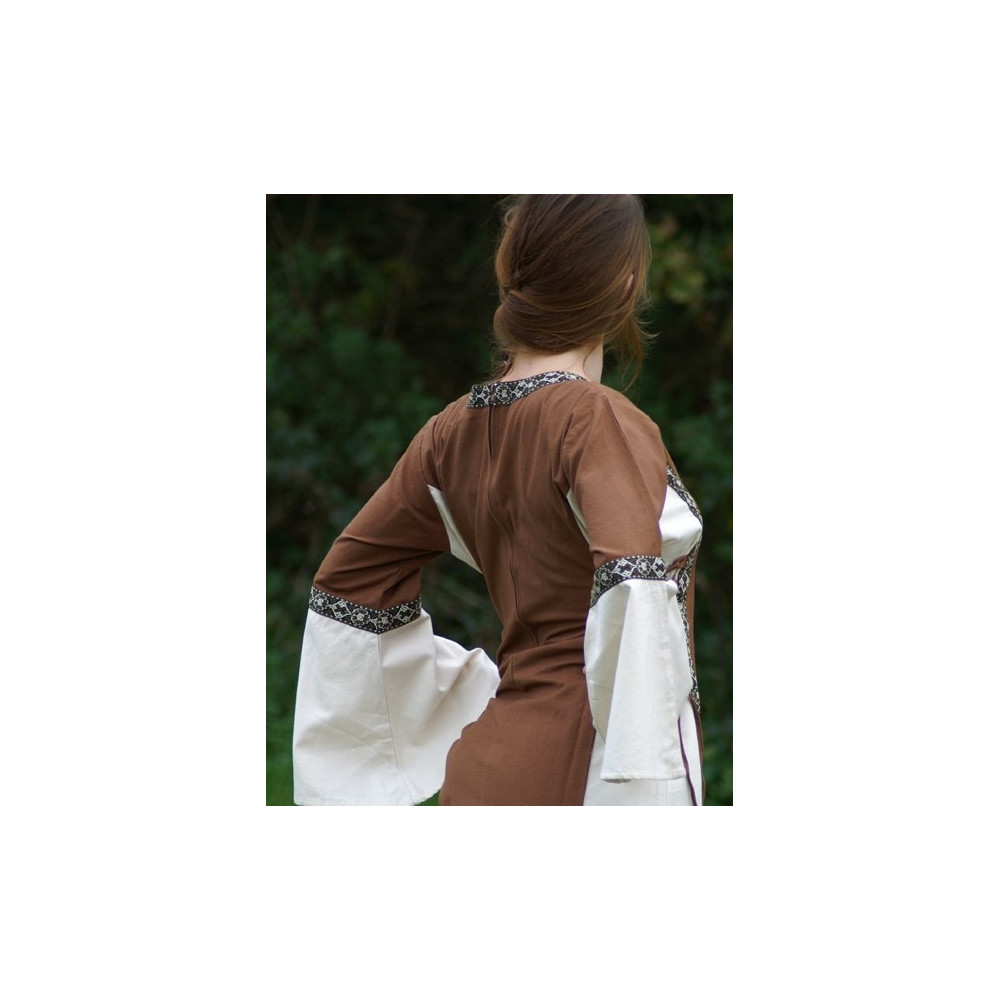
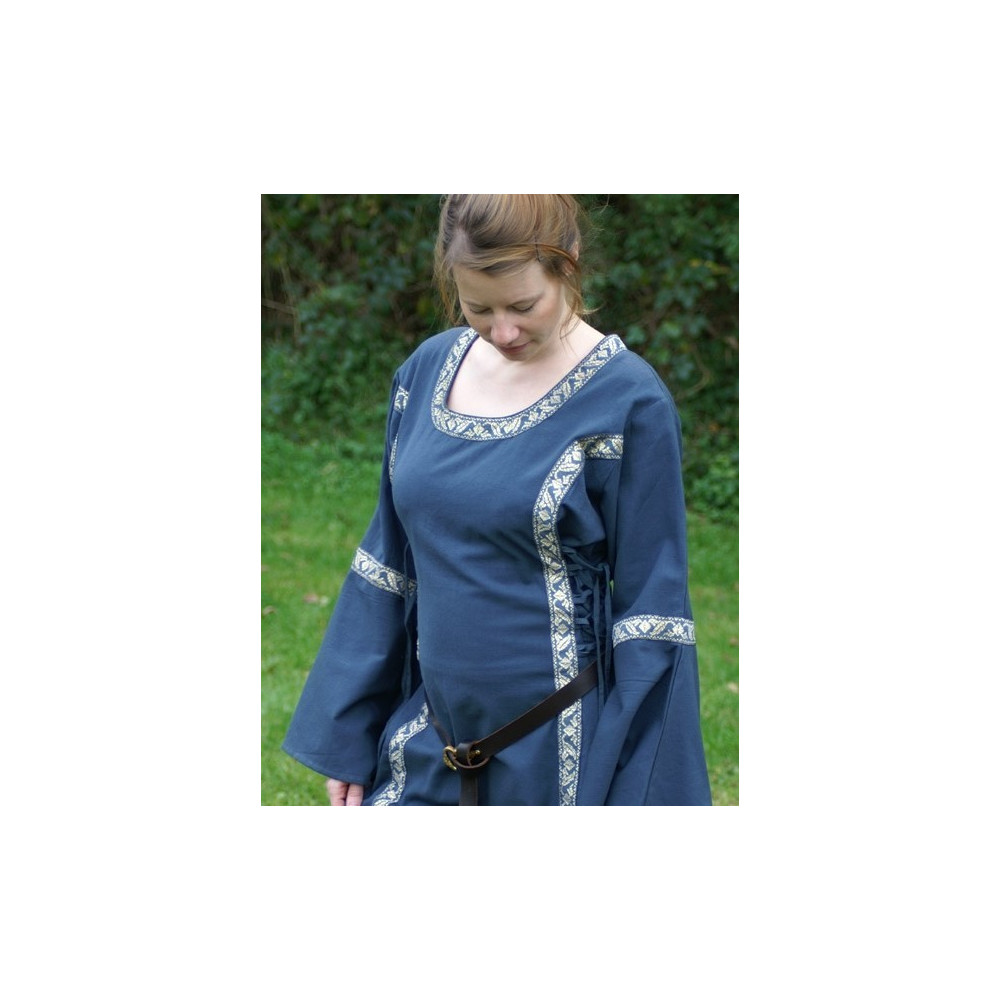




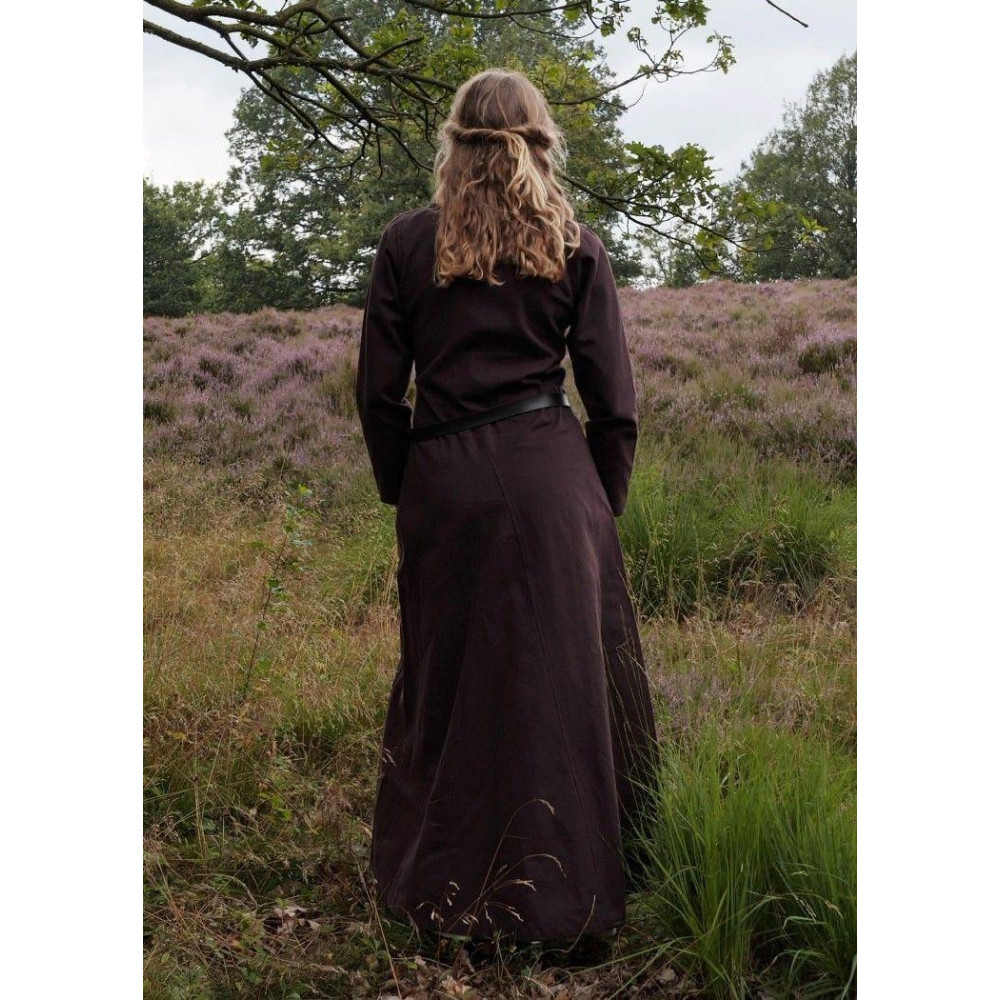
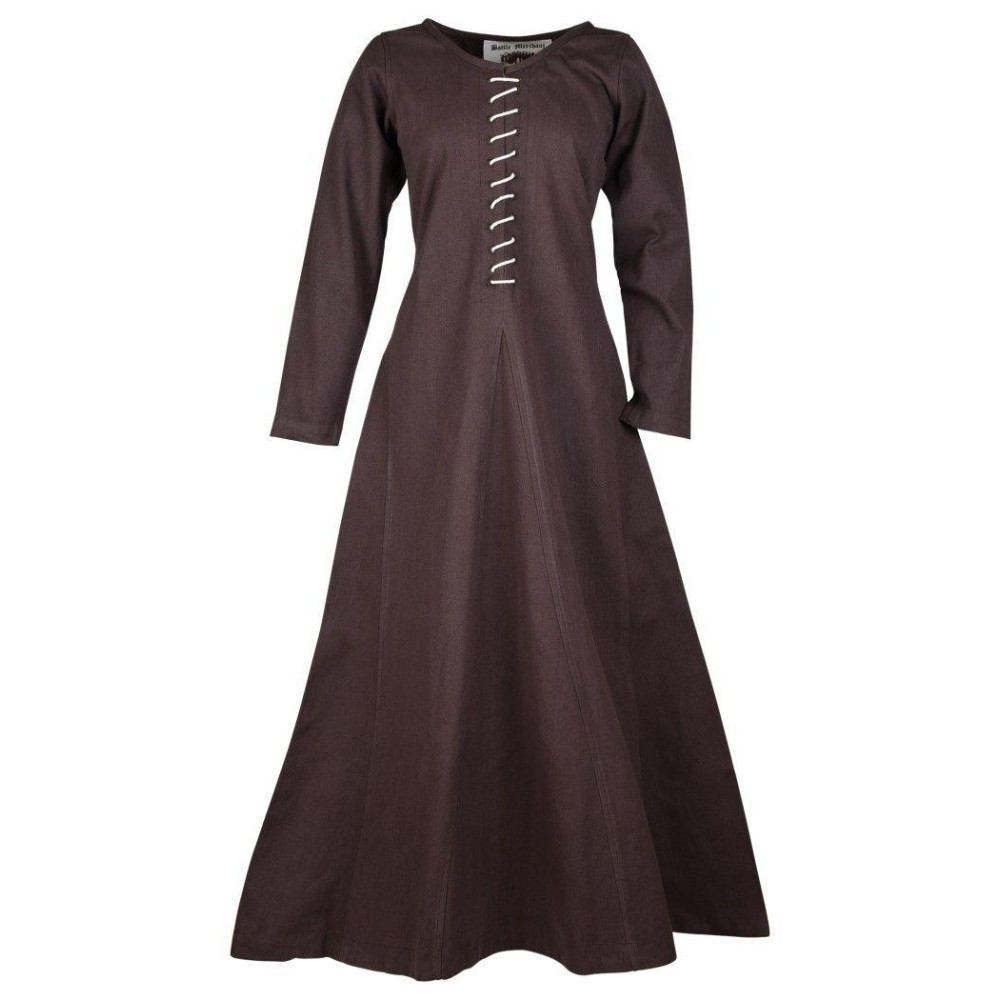





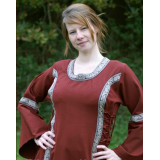


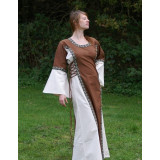


Medieval Tied Kirtle / Ava Cotehardie, long sleeves, brown
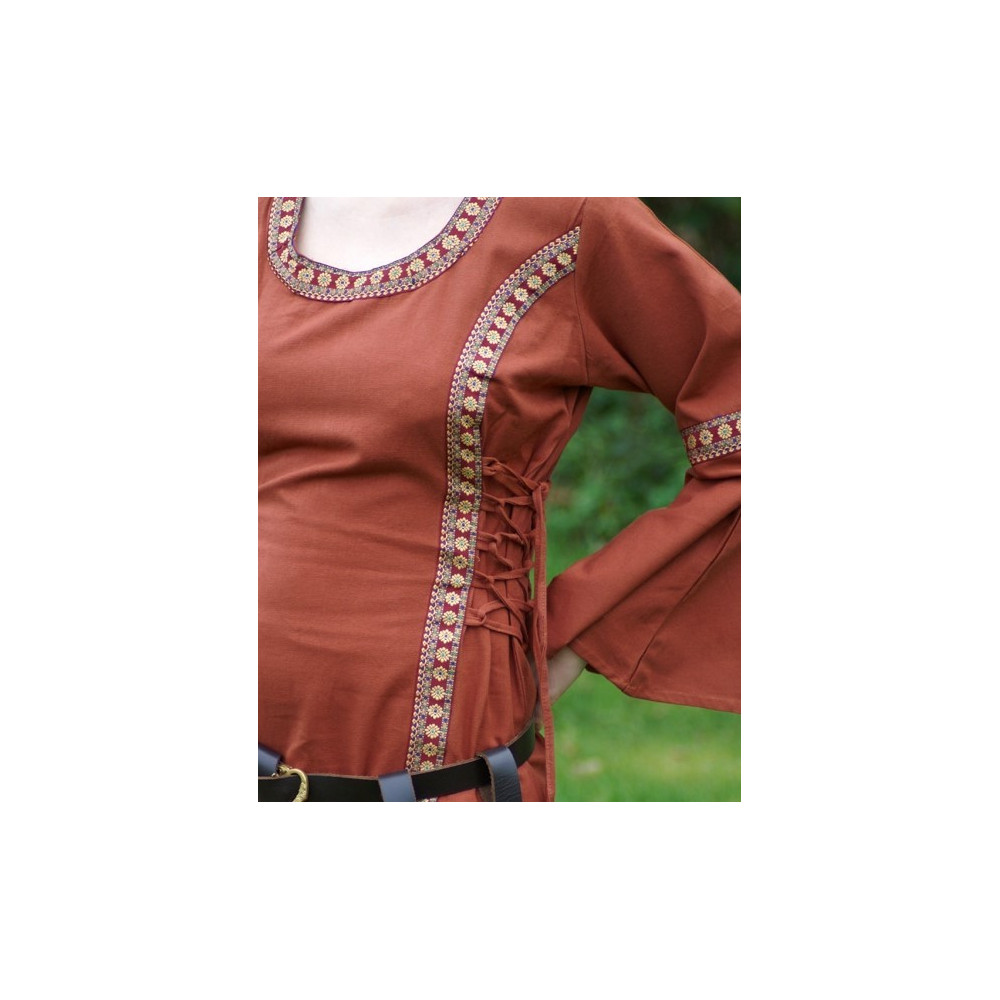
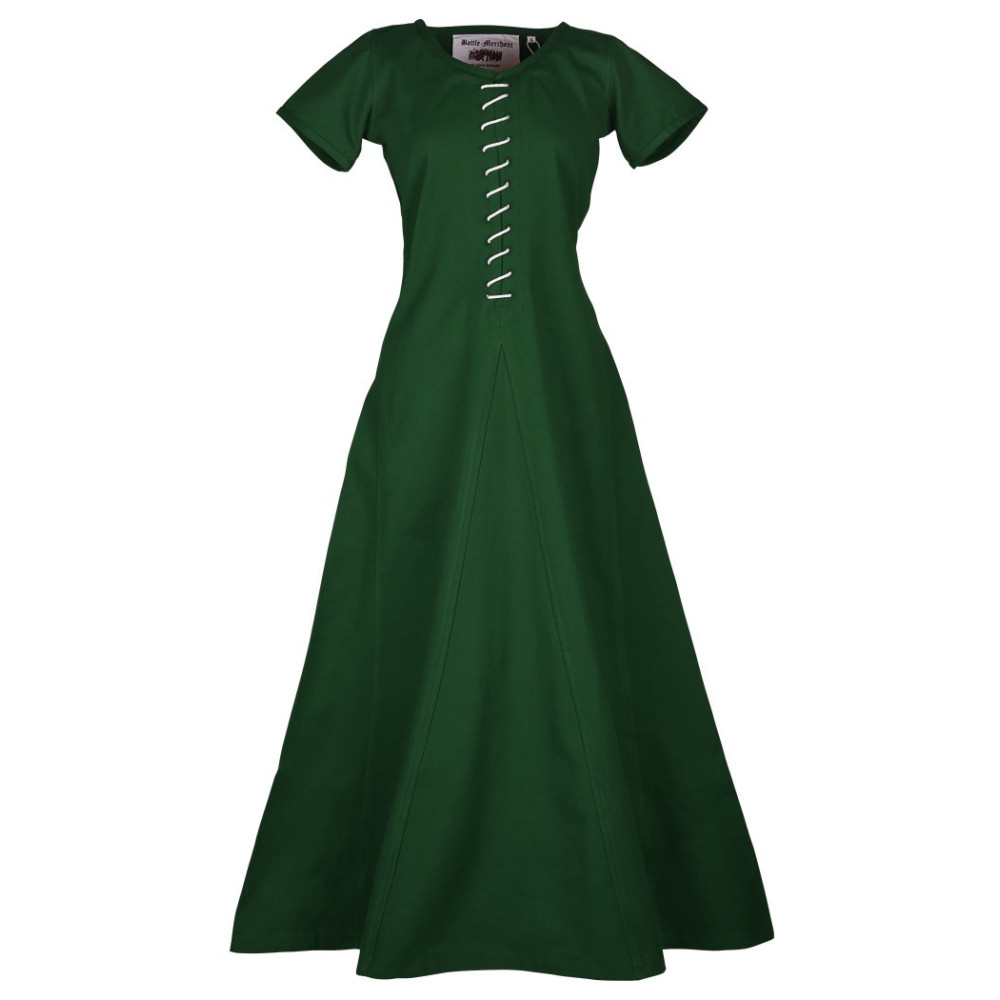
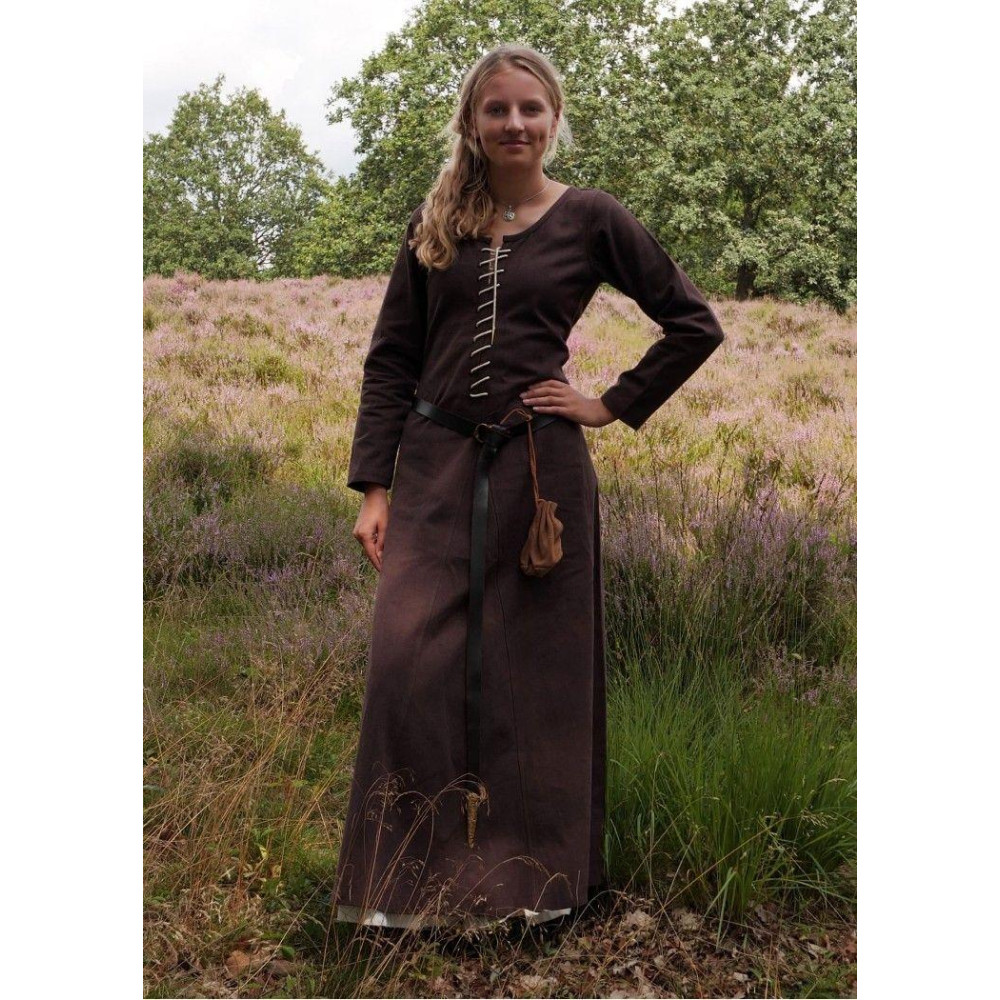
This medieval long-waisted dress or skirt is made of sturdy cotton fabric (canvas). The skirt piece is equipped with so-called gores (triangular/wedge-shaped pieces of fabric) that provide a generous touch, and the upper part features a central front loop made of thick cotton for individual adjustment. The ends of the mooring rope are equipped with metal tips that facilitate threading into the sewn eyelets.

(editar com o módulo Customer Reassurance)

(editar com o módulo Customer Reassurance)

(editar com o módulo Customer Reassurance)
The cut of this dress is based on medieval illustrations from the 13th to the 15th centuries. The cotehardie, which evolved from the french baggy cotte and roughly translates into daring cotte, presumably owes its name to its bold and fair nature.
A typical kirtle or cotehardie usually featured loops or a button-up clasp on the central front. The introduction of laces and buttons as functional fasteners (instead of pure ornamental items) is what made tailor-made and adaptable fashion possible. Another distinctive feature of these dresses was the wide neckline, which looked increasingly lower over time and was particularly popular among women in the late Middle Ages and Renaissance.
The cotehardie was usually combined with a shirt or blanket, a veil and a narrow belt. The short sleeve variant also used to be used with removable and interchangeable sleeves.
Historical illustrations of the 15th c. kirtles can be found, among others, on the June calendar page of the Duke of Berry's Book of Hours, an illuminated French manuscript (original title: Les Très Riches Heures du duque de Berry) or in the simple medicine book (woman and unicorn) illustrated by Robinet Testard.
| Size chart - Female - Dress | |||||||||
|
96104116128
Game Of Thrones - Lannister Shield with Wall Mount
Officially licensed replica of HBO's hit TV series Game of Thrones ®
House Lannister of Casterly Rock is one of the oldest, most powerful, and wealthiest Great Houses of Westeros. They are the Overlords of the Westerlands and the Wardens of the West. The Lannister dynasty ruled the Kingdom of the Rock for thousands of years before falling to the Targaryen conquest of Westeros. Although it fell on hard times under Lord Tytos Lannister, it was restored to its former glory by his son, Lord Tywin Lannister. The arranged marriage of Tywin's daughter Cersei to King Robert Baratheon brought the family to King's Landing. Cersei's twin brother, Ser Jaime, is a knight in the Kingsguard. The secret incestuous relationship between Cersei and James resulted in three children who were considered King Robert's legitimate sons and heirs.
This replica Lannister infantry shield is an officially licensed collectible, meticulously recreated from the actual prop used in HBO's epic fantasy drama TV show, Game of Thrones ®. It has been crafted with great attention to detail and no effort has been spared to accurately reproduce the authentic features found in the original piece. This large oval shield made of fiberglass and resin is engraved and painted with a lion (the symbol of House Lannister), lined with black felt, and fitted with leather straps on the back.
Strictly limited to 1,000 pieces, each shield is serialized and comes with a certificate of authenticity. The delivery also includes a wooden wall mount with slots that will accommodate most swords and allow you to display up to three of your favorite swords behind the shield (the swords shown here are NOT included in the delivery!).
Please note that this shield is intended for display purposes as a collector's item only.
Details:
- Material: fiberglass and resin with felt overlay and leather straps on the back
- Dimensions: approx. 80 x 47 cm
-Incl. Certificate of authenticity and wall bracket in black painted wood with 3 slots to hang sword.
Medieval Viking helmet in polished steel with mesh dimension, 1mm thick and leather strap. Includes foam cushion. T-M (circumference of 60 cm). T - L (67 cm circumference).
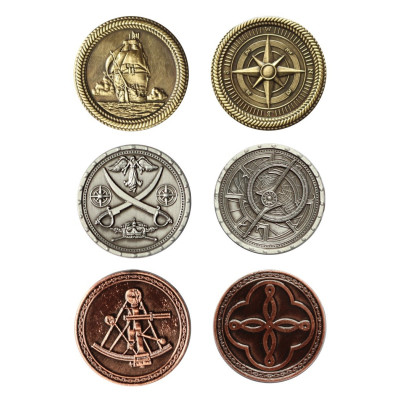
These coins are, due to their innovative design, a true eyecatcher and perfectly suited as in-game currency for LARP!
IT money is mandatory for any type of character, whether as a salary for jobs such as ongoing tasks, purchase of smaller items, or use in gambling.
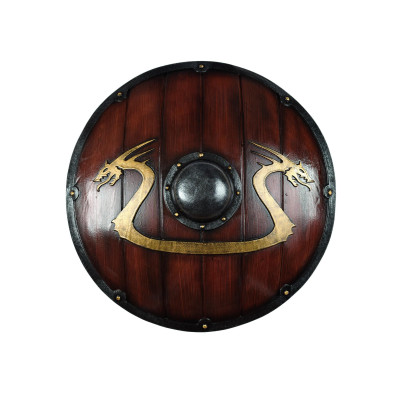
A round shield in wood finish with golden dragon ornament, an iron-colored edge and shield bounce. The centrally mounted handle makes the shield easy to handle and guarantees the wearer a good chance to fight enemy attacks.
Our combined pair of Visby shoulder pads with a mountable upgrade to mesh quota and padded armor are well designed and fully functional, significantly improving armored protection!
Expertly crafted with sturdy 16-gauge steel, these pauldrons would surely complement the power of their legendary Viking armor. The elongated tear-shaped design perfectly covers the shoulders and its elongated structure sparsely protects the upper arms, ensuring that some steel is present to prevent a cut. To attach it to your armor, a set of robust GENUINE LEATHER ROPES is supplied along with this set of shoulder pads.
This impressive pectoral was handmade in steel by our main blacksmiths and was wrapped in brass and aged. Impressively detailed, even with the famous bull carved in metal that is in the center over the heart.
If you're a fan of Final Fantasy VII and admire the character Sephiroth, then Masamune's hand-forged sword is a must-have. Measuring an impressive 167.5 cm in total length, this sword is a work of art that can be yours right now. It's hard not to be impressed when you hold such an iconic sword in your hands.
This Sephiroth Masamune sword is the hand-forged version of the famous weapon from "Final Fantasy VII". The blade is fully sharpened and has a high-quality support and care set. At 126.5 cm long, its blade is long enough to make you feel like a true warrior on the battlefield. In addition, with a handle length of 40.5 cm, it is easy to handle and hold comfortably. This sword is also relatively lightweight, weighing only 1945g, which will allow you to use it effectively in combat and on the move.
The story behind the Masamune sword is fascinating. In "Final Fantasy VII", Sephiroth is an antagonistic character who seeks revenge and is known for his skill in handling Masamune. In the game, the weapon is said to have been forged by a man named Masamune, who created it as his ultimate masterpiece. The sword is revered in the Final Fantasy universe and is an important part of the story.
The functional 167 cm hand-forged Sephiroth Masamune Katana sword 40543 is a masterpiece in its own right and is easily recognizable as a sword from Square Enix's Final Fantasy series. If you're a sword collector or a Final Fantasy fan, you can't miss this unique piece in your weapon collection.
Child's Tabardo, Teutonic Knight
were used by many knights to identify themselves as crusaders. The coat of arms on them (also called Surcoat or Surcot) appeared in the 12th century and was worn by the knights over their armor or mesh quota on the battlefield. With the colors and the cross, it became clear in the battle who was a friend and who was the enemy.
Handle: Aluminum
Blade: Stainless Steel
Blade size: 9.2 cm
Includes:
-Window handle
-Strong seat belt
Presentation: color box
Here you see an exact replica of the distinctive Bowie knife used by Sylvester Stalone in the third Rambo movie. This high-quality replica has been created with the finest materials. A leather sheath with a beautiful grain is included.
Our traditional strong arches are made of rotan palm wood of the highest quality. This wood is very flexible and robust. The strongbow line offers the right bow for each archer. They are suitable for medieval reenactment and Larp. Authentic appearance, ergonomic qualities and good value for price combine to make this strong bow line an excellent choice for traditional archers.
This long bow does not have an arrow notch and can be used by both dominant right-eye and left-eye archers.
Details:
- Shaft-to-shaft length: 70" - about 180 cm
- Arrow length: 28"
- 20 - 45 lbs.
- Color: dark brown, natural stain
- B/H Inklusive Sehne aus Dacron.
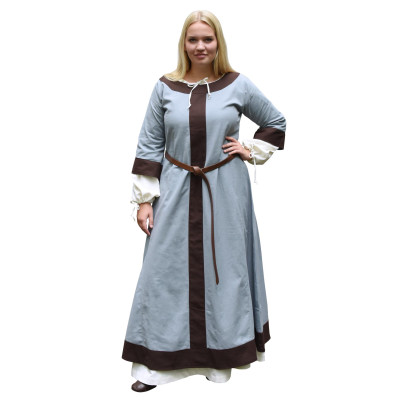
Medieval Gudrun dress, blue-grey/brown
This loose-cut dress has slightly wide 3/4 sleeves and so-called gores on the sides, extending from the waist to the hem. Gores, wedge-shaped/triangular pieces of fabric added to expand the shape of a garment, gave the medieval clothes a generous touch. It is conceived as an outer garment of the early Middle Ages, as clearly shown by the contrasting details of colors (its most notable feature). The collar has button closure and slit in the center of the back. The dress is made of plain cotton fabric and is best worn with a leather belt.
The appearance and cut of this dress are based on archaeological finds (sixth century woman's tomb find in Asseln, Dortmund district, Germany) and medieval illustrations (ninth century. Stuttgart Psalter). The costume of the early Middle Ages was characterized by long coats, simple patterns consisting mainly of stitched rectangles and contrasting color details. The dress is therefore ideal for depicting Vikings, Lombards, Merovingians and Franks.
Details:
- Available sizes: S, M, L, XL, XXL
- Color: blue-gray/brown (also available: blue/red, red/blue)
- Material: 100% cotton
- Length total size M: approx. 142 cm (measured from the highest point of the shoulder to the lower sheath)
- Care instructions: Machine wash at 40°C, delicate cycle, do not dry in dryer
| Size Table - Women - Dress | ||||||||||||
|
How to find the right size:
- To take the correct measurements of your body and determine the size of your clothing, always wrap the tape measure horizontally around your body in the widest part.
- For dresses, sizes are based on the circumference of your chest.
- If you happen to fall between two sizes, we recommend that you increase one size.
- Ease is included in the standard and reflected in the finished measurements.
Attention:
The delivery includes only the dress! The other items in the photo above are available separately in our online store.
Cid's tizona dagger with scabbard, guard and pommel with bronze details. With a total size of 40 cm, steel blade. Impressive in every aspect, this perfectly-sized sword is the essential weapon for lovers of history and historical replicas. The elegant scabbard, careful guarding and bronze detail on the hilt further elevate the quality and beauty of this sword. And with a strong and durable steel blade, this dagger is a useful and authentic tool for any collection. Get it and feel the thrill of carrying an authentic historical piece in your hands!
Overall size: 40 cm
Blade size: 24 cm
Blade thickness: 2.4 mm
Weight: 240 gr
Medieval Tied Kirtle / Ava Cotehardie, long sleeves, brown
This medieval long-waisted dress or skirt is made of sturdy cotton fabric (canvas). The skirt piece is equipped with so-called gores (triangular/wedge-shaped pieces of fabric) that provide a generous touch, and the upper part features a central front loop made of thick cotton for individual adjustment. The ends of the mooring rope are equipped with metal tips that facilitate threading into the sewn eyelets.