- Out-of-Stock
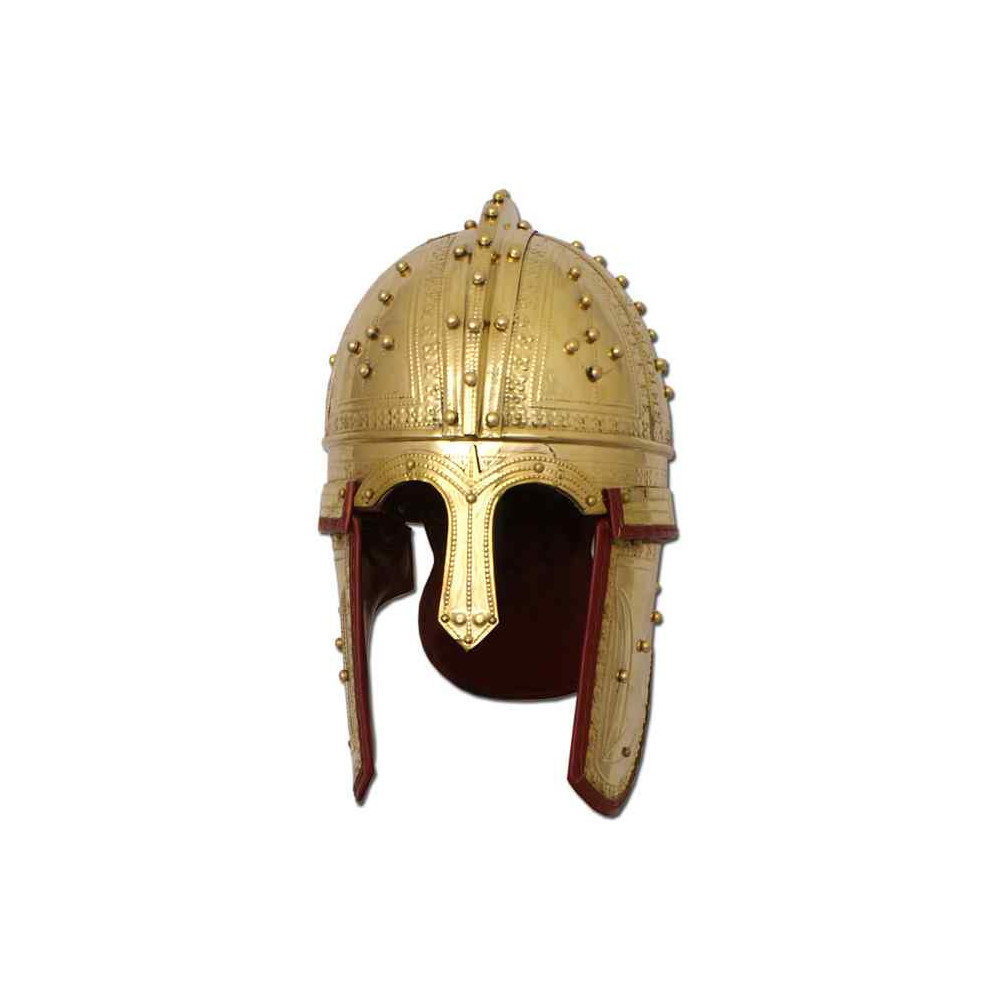


Deurne helmet, 4th century
Elaborate reconstruction of a Roman cavalry helmet like that found near Deurne in the Netherlands. The intricate ornamentation suggests that the user was a high-ranking officer. A Roman coin found near the helmet has the date of 319, so the helmet is very likely from the beginning of the 4th century.

(editar com o módulo Customer Reassurance)

(editar com o módulo Customer Reassurance)

(editar com o módulo Customer Reassurance)
The helmet crown is made of 6 individual pieces (spangen). Jowl parts are easily movable. The nape guard is fastened with two leather straps with buckle and is removable and adjustable. The helmet is handmade from steel and brass and is comfortable due to its leather jacket. Nasal, jowel and nape pieces are covered with red leather inside.
Details
- Size: approx. 61 cm
- long distance (back to front): approx. 21.5 cm
- short distance (ear to ear): approx. 18 cm
- Weight: approx. 3 kg
Imperial Roman Helmet Gallic -G- Weisenau, steel, crested
Replica of the famous helmet worn in the sand by the gladiators of Italy. The helmet is made of high quality steel and with brass decorations. The product consists of two parts: the helmet and the face protection that is attached to the helmet with 3 hinges. The helmet has a circumference of 72 cm.
Roman imperial helmet, but with other engravings like the eagle and the golden tones. The Roman Legion was the basic infantry military unit of Ancient Rome. It consisted of a heavy infantry corps of about 5,000 and later 10,000 infanteria soldiers and several hundred knights.
Coolus -G- Drusenheim / Hagenau, Brass
Very authentic replica based on a helmet from the late 1st century AD found in Drusenheim (near Hagenau / Alsace), France.
This type of helmet is often called hagenau type in reference to the location of the discovery.
Brass Roman infantry auxiliary helmet
An authentic replica of a 1st century Roman auxiliary infantry .C. which was found near Mainz, Germany
Also included is a padded cotton cover to wear under the helmet
Suitable for head circumference up to 60 cm
Spartacus is a Thracian soldier who offers to fight in the Roman Auxiliary against a common enemy of Thrace and Rome. As punishment for challenging the Roman commander Legatus Claudius Glaber, he is condemned to die in the gladiator arena. Against all odds, kill four gladiators and survive. His sentence is commuted to slavery and Batiatus buys it to be trained as gladiator in his ludus. His rebellious tendencies are tamed by the promise of one day reuniting with his wife Sura.
This Spartacus metal helmet has a movable visor, a fish-shaped Roman crest and a long, real tail. Antique finish. It has an adjustable lining.
Helmet holder not included.
The Montefortino helmet, named after the site near the present-day Fermo area (Italy), is the most documented type of helmet of the Roman legions, and has been worn during various stages of development from the Pic wars (approx. 260 BC) to the time of Augustus Caesar (63 BC - 14 AD).
Includes a padded cotton cover.
Intercisa II, steel
Authentic late Roman replica based on a helmet from the 3rd century A.D. found in Intercisa, Hungary.
The helmet has a riveted, adjustable, high-class padded leather lining.
Details:
- Suitable for head circumference up to 61 cm
- Long distance (from back to front): approx. 21 cm
- Short distance (ear to ear): approx. 19 cm
- Weight: approx. 1.10 kg
Roman imperial helmet with mask. The original is exhibited at the Shelby White Collection Museum in New York. Head circumference up to 62 cms.
Being in the legion, you need protection from projectiles and blows without disturbing your vision or your breathing! After all, you legionnaires are well known for walking hundreds of miles on the empire road, from one battlefield to another, and walking miles has never been easy for those wearing a fully enclosed helmet.
The Roman helmet worn during the Empire is the product of a slow evolution of the first simple Italian bronze helmet to the Celtic-influenced helmet worn by the legionaries of Augustus, Trajan, Hadrian and all other famous Roman emperors.
The fact is that this remarkable helmet proves surprisingly versatile and strikes a perfect balance between protection and mobility. Just pair it with one of our lorica hamata and you'll get an ideal combination for your next LARP or reconstitution! A great look without harming your vision and freedom of movement.
This gorgeous helmet is handmade 18 gauge soft steel, lined with a comfortable and secure synthetic leather lining. A circumference of approx. 68 cm makes almost all head sizes fit. The historic crest attached to the top will make your Roman outfit stand out!
Replica of a Celtic helmet, so prevalent among soldiers glucose around 100 ad. This helmet follows an original oven in the "Forêt de Rouvray" in northern France. There was probably horse hair tied to the peak of the helmet.
This helmet features a comfortable leather inlay and a chin strap
Replica of the Imperial Roman Rooster Helmet. The original helmet was found near Weiseneau, Germany. Includes padding. One size one, approx. 60 cms.
Replica of a Celtic helmet approx. 300 - 200 b.c.
These helmets were mainly used in the Alpine and northern Regions of Italy. There was probably horse hair tied to the peak of the helmet.
Delivery includes a comfortable leather inlay.
of the Roman imperial legions. Faithful reproduction,
Deurne helmet, 4th century
Elaborate reconstruction of a Roman cavalry helmet like that found near Deurne in the Netherlands. The intricate ornamentation suggests that the user was a high-ranking officer. A Roman coin found near the helmet has the date of 319, so the helmet is very likely from the beginning of the 4th century.